


The CEO of Ghana Exim Bank, Sylvester Adinam Mensah, has said that the country’s agricultural transformation must fully include youth and women.
He emphasized that their participation is critical for building sustainable, innovative, and globally competitive agribusinesses.
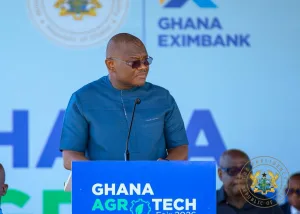
Speaking at the Ghana Agrotech Fair 2026 at the Black Star Square on Tuesday, March 17, 2026, Mr. Mensah highlighted the importance of technology adoption and strengthening linkages across agricultural value chains.
He explained that the fair is designed not only to showcase innovations but also to open doors for startups, local fabricators, and entrepreneurs to expand their businesses and compete regionally and globally.
“This fair is both a showcase and a catalyst for transformation. It should manifest in the form of new partnerships, stronger businesses, better tools for farmers, increased processing capacity, and export-ready enterprises.” he said

Mr. Mensah reiterated that Ghana’s agricultural future depends on sustainability, efficient resource use, climate-conscious practices, and resilient systems capable of withstanding shocks.
“Sustainability means supporting technologies that improve productivity while protecting the environment. It means building businesses that are profitable, inclusive, and capable of lasting beyond today. And it means ensuring that women, youth, and small enterprises are fully part of this transformation,” he added.

He emphasized that no single institution can achieve this alone. Progress requires collaboration between government, financial institutions, industry, scientists, researchers, farmers, and innovators.
“Our mandate at Exim Bank is to help build a strong export-led economy by promoting value addition and supporting productive sectors. Agriculture begins at the farm gates with strength through processing, packaging, storage, distribution, and export,” he said.

Mensah concluded by encouraging stakeholders to use the fair as a platform to deepen partnerships, invest in the future, and support a modern, competitive, and globally relevant agricultural sector.
“This is an important step in positioning Ghanaian products competitively in regional and global markets while empowering youth and women to be at the forefront of the country’s agricultural transformation,” he added.