

























































The opposition New Patriotic Party (NPP) has topped the incumbent National Democratic Congress (NDC) in a latest survey conducted by the Africa Policy Lens (APL) National Voter Perception Poll.
The “National Voter Perception Poll,” according to the APL, was conducted between 23 and 30 May 2026 to assess public opinion regarding political preferences, electoral participation, economic conditions, and perceptions of the overall direction of Ghana.
The survey obtained 6,483 valid responses from eligible voters across all sixteen regions of Ghana through a nationwide SMS polling platform.
The findings indicate that the New Patriotic Party (NPP) currently enjoys a measurable advantage in national vote intention, securing 48.8% support compared to 37.6% for the National Democratic Congress (NDC), with 8% of the respondents undecided.
According to the findings, 2% noted they would vote for either party, while 3% said they won’t vote at all. The analysis further reveals exceptionally high NPP voter retention, significant levels of economic anxiety, notable regional variation in political preferences, and substantial electoral fluidity among younger voters.
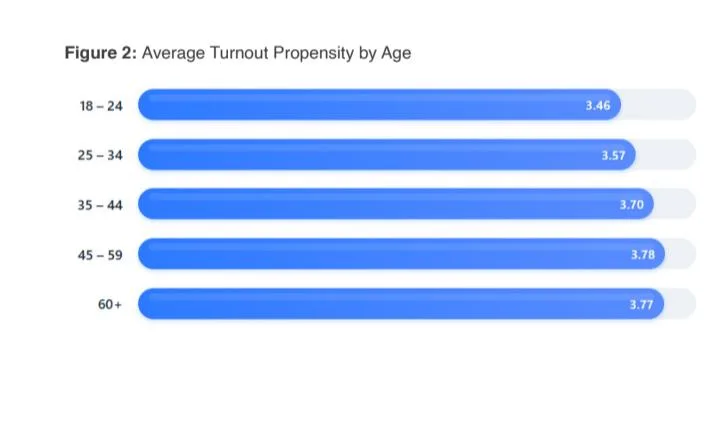
The survey forms part of APL’s broader objective of generating evidence-based civic intelligence to inform public discourse, policy formulation, democratic accountability, and electoral analysis.
Highlighting gender as one of the most important demographic cleavages in the survey, male respondents display substantially stronger support for the NPP, while female respondents are more likely to support the NDC.
About 44% of females preferred the NDC, and 32.4% also preferred the NPP, with 2.3% opting for other parties, 14.4% undecided, and 6.9% stating they won’t vote. In the male voter preference, 51% want the NPP, 36.7% for the NDC, 1.7% for other parties, and 7.5% were undecided.
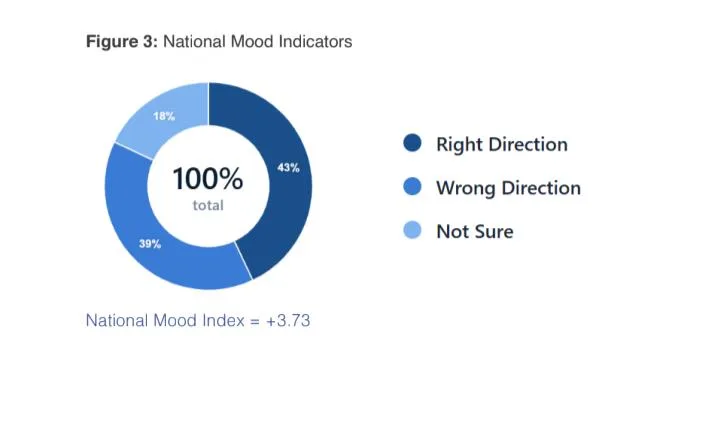
Additionally, 3.1% indicated they won’t vote. Per APL’s latest poll, the current political preferences of both the NPP and NDC are shaped not only by partisan loyalties but also by citizens’ evaluations of economic conditions, personal well-being, and the overall direction of the country.
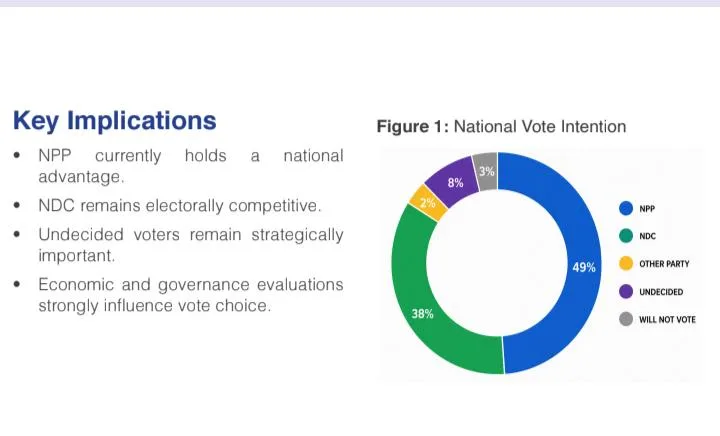
The APL indicated that the electoral environment remains competitive, although the NPP has an 11% advantage in national voter preference.
Africa Policy Lens (APL) is an independent Ghana-based public policy think tank and research organization committed to advancing evidence-based policymaking, democratic accountability, and sustainable development across Africa.
GHANA-NATIONAL-VOTER-PREFERENCE-AND-ELECTORAL-BEHAVIOUR-SURVEY-2026_copy