




















Recent global crises offer an important lesson for Africa, particularly the junta-led countries of the Sahel: great powers rarely come to the rescue of smaller states once their own strategic interests are at stake.
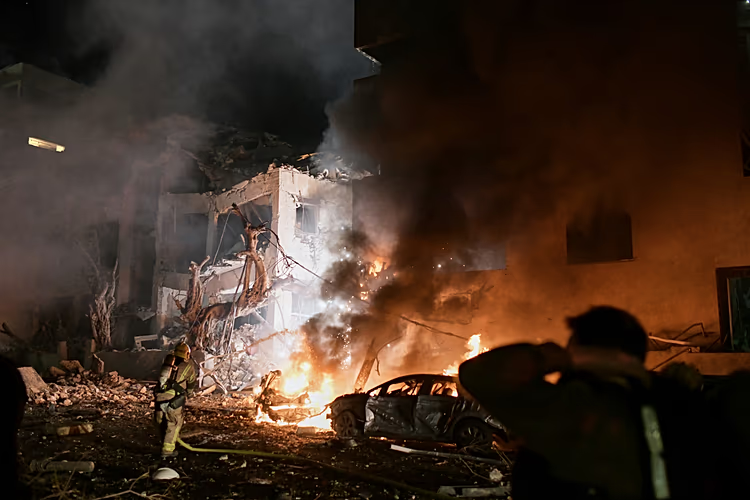
The unfolding tensions between Iran and Israel, and the cautious responses from both Russia and China, illustrate a central truth of international politics: alliances are rarely built on loyalty; they are built on interests.
For countries such as Mali, Burkina Faso, and Niger, which have recently drawn closer to Moscow while distancing themselves from the ECOWAS and Western partners, this reality should prompt careful reflection.
The mirage of great-power protection is a recurring theme in global geopolitics.
Nations that rely too heavily on external patrons often discover, at the moment of crisis, that the protection they assumed was guaranteed was never truly promised.
Iran provides a clear illustration.
Over the years, Tehran has cultivated strategic partnerships with both Russia and China.
In January 2025, Iran and Russia signed a 20-year Comprehensive Strategic Partnership to deepen economic, military, and political cooperation.
Iran has supported Russia’s war effort in Ukraine by supplying drones and other military equipment, while Moscow has reciprocated with technological and defense support, including the S-300 air defense system.
China, for its part, has entered into a 25-year strategic partnership with Iran and has become Tehran’s largest trading partner and the biggest buyer of its crude oil.
Yet despite these deepening ties, neither Moscow nor Beijing has demonstrated any willingness to directly intervene militarily on Iran’s behalf during its confrontations with Israel and its allies.
Their partnerships with Tehran are strategic and transactional, not binding military alliances comparable to NATO’s collective defense principle.
Even Russia’s own officials have been candid about this reality.
Kremlin spokesperson Dmitry Peskov recently stated that Russia had received no request for military assistance from Iran and had no intention of becoming directly involved in the conflict.
In essence, Moscow’s message was simple: “It is not our war.”
This should not come as a surprise.
Russia is already heavily engaged in Ukraine and cannot afford another major military confrontation, especially one that could draw in the United States and NATO. For Beijing, the calculus is also pragmatic.
China’s primary concern is economic stability and energy security, not direct military confrontation in the Middle East.
The lesson is straightforward: in international relations, even the closest partners ultimately act in accordance with their own national interests.
For Africa, and particularly the Sahel, this lesson carries profound implications.
Over the past few years, the region has increasingly become a geopolitical arena where major powers compete for influence.
France once maintained a strong military presence through Operation Barkhane.
The United States has operated intelligence and surveillance facilities to monitor extremist threats.
Russia has expanded its footprint by providing security assistance to governments that have expelled Western forces.
China, meanwhile, has deepened economic engagement through infrastructure projects, mining partnerships, and large-scale development contracts.
Each of these actors pursues its own strategic interests. None operates purely out of altruism.
The Sahel’s vast natural resources- uranium in Niger, gold in Mali and Burkina Faso, and oil in Chad and Niger- make the region geopolitically attractive.
Yet this same abundance also exposes the region to external competition.
Decades ago, Ghana’s first president, Kwame Nkrumah, warned that a divided Africa would remain vulnerable to external manipulation. His message remains relevant today.
If African states fail to build internal strength and regional solidarity, they risk becoming arenas where global powers pursue their rivalries.
This does not mean African countries should isolate themselves from the world.
Strategic partnerships are necessary in today’s interconnected global system.
However, genuine independence means having the ability to engage multiple partners without becoming dependent on any single power.
For the Sahel, the challenge is particularly urgent.
The region faces violent extremism, economic fragility, weak institutions, and recurring political instability.
Military coups may have changed governments, but they have not addressed the deeper structural causes of insecurity.
Also, Russia’s growing presence may provide short-term political and military support, but it does not resolve underlying governance problems such as corruption, poverty, and weak state institutions.
Moreover, the Sahelian juntas face a risk that Iran and Venezuela managed to avoid.
Both Tehran and Caracas possess significant oil wealth, which has allowed them to withstand sanctions and international pressure for years. Their natural resources provide fiscal buffers and strategic leverage. The Sahel’s economies are far more fragile.
Countries like Mali and Burkina Faso have GDP per capita levels under $900 and rely heavily on external aid, regional trade, and mining revenues.
A geopolitical strategy based solely on anti-Western rhetoric may generate domestic political support, but without economic resilience, it could deepen isolation and financial instability.
Ultimately, the Sahel’s long-term stability will not be secured by choosing one foreign patron over another.
It will depend on strengthening governance, building credible national institutions, and investing in regional cooperation. Africa’s future cannot rest on the promises of distant powers. It must be built on the strength of its own institutions, leadership, and people.
As former U.S. President Barack Obama once observed during his visit to Ghana, “Africa does not need strong men; it needs strong institutions.”
While the statement came from outside the continent, the underlying message aligns closely with the vision long championed by African thinkers and leaders.
The real path forward for the Sahel lies not in replacing Western influence with Russian or Chinese patronage, but in pursuing genuine strategic autonomy: An Africa that engages the world confidently yet remains anchored in its own priorities.
For the countries of the Sahel, the lesson from Iran and Venezuela is clear: great powers may be partners, but they are rarely protectors. In addition, Africa’s destiny must never depend on the calculations of others.
Joseph McCarthy is an analyst and researcher focusing on governance, security, and political transitions in the Sahel.
He writes on geopolitics, development, and African diplomacy.
Contact: 0264354064 | joecarthy30@gmail.com