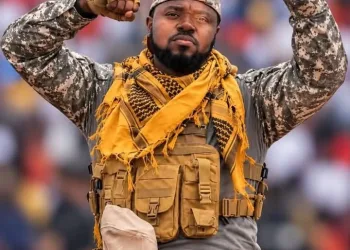



























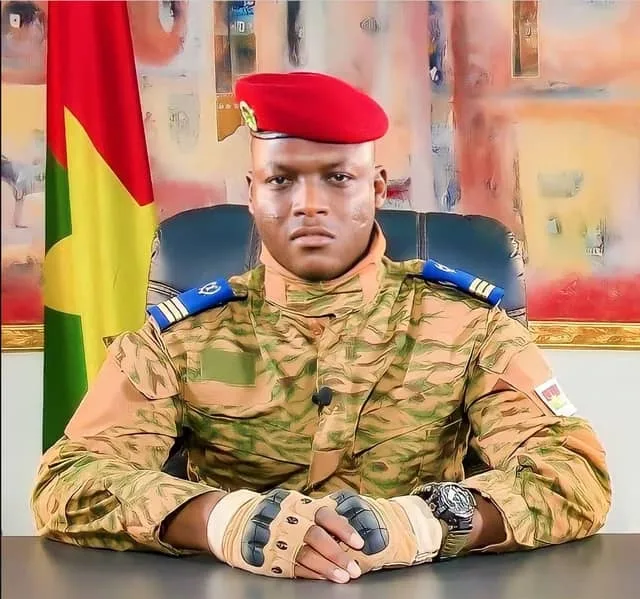
When Captain Ibrahim Traoré declared that democracy is “not suited” for Africa, he was not making a philosophical argument. He was making a political one, rooted not in theory, but in survival.
This is because even if democracy is flawed, it still has one unforgiving strength: it holds leaders accountable and accountability is precisely what Traoré appears keen to avoid, and his fear of the ballot is his most damning confession.
He came to power in Burkina Faso in September 2022 on the back of a familiar promise to restore security, revive the economy, and return the country to stability. The justification was compelling: a nation under siege from jihadist violence needed decisive leadership.
Unfortunately, nearly four years later, the results tell a different story. Insecurity has worsened dramatically.
Data shows that fatalities linked to militant Islamist violence have nearly tripled compared to the years before the coup. Civilian deaths have surged.
Burkina Faso now ranks among the most terrorism-affected countries in the world. This is not progress. It is a regression.
Economically, the picture is no better.
Agricultural production has been disrupted by insecurity, large swathes of farmland have become inaccessible, and displacement has hollowed out local economies.
Inflation may have slowed statistically, but for ordinary citizens, food and transport costs remain painfully high.
Put simply: the promises have not been met. This is where democracy becomes inconvenient.
This is because in a democratic system, performance has consequences. Citizens vote. Leaders are judged. Power changes hands, peacefully.
Sadly, in Burkina Faso today, that mechanism has been suspended. Elections promised for July 2024 have been pushed into uncertainty.
Political parties have been weakened. Electoral institutions have been dismantled. The space for dissent is shrinking. This is not governance reform. It is power consolidation.
The logic is straightforward: elections would expose the gap between rhetoric and reality.
They would offer citizens a chance to pass judgment and that judgment may not be favourable. So the vote is delayed.
Yet, this is precisely why democracy, imperfect as it is, remains indispensable.
It provides a peaceful exit for failed leadership. Without it, change becomes uncertain, and instability often follows. Traoré’s position inadvertently proves this point.
If his policies were working, if security had improved, if the economy had stabilised, he would not fear elections.
He would seek them as validation. Leaders confident in performance do not run from the ballot. They run to it.
What is unfolding instead reflects a deeper and more troubling pattern, one that can only be described as internal colonisation.
This to the extent of the fact that dictatorship, at its core, is not liberation. It is the concentration of power in the hands of a few, ruling over the many without sustained consent. It mirrors colonial logic, only with local actors: control, extraction, and suppression.
To this odious end, the citizens become subjects. The state becomes an instrument of domination.
This is why anti-imperialist rhetoric, as being propagated by Traoré and his admirers, when used to justify repression, rings hollow. You cannot claim to resist external domination while imposing internal domination. You cannot speak of sovereignty while silencing your own citizens.
You cannot preach liberation while denying people the fundamental right to choose their leaders.
The most humiliating aspect of colonialism was not just economic exploitation; it was the denial of agency.
The assumption that people could not think, decide, or govern themselves. Internal authoritarianism replicates that same humiliation. It treats citizens not as participants in nation building, but as spectators in decisions that define their future.
There is no doubt that across Africa, there is growing frustration with governance failures and unmet expectations. That frustration is real. It is justified. Abandoning democracy is not the solution.
The problem is not democracy itself; it is the failure to make it work effectively. Then the evidence across the continent is clear.
Countries like Ghana and Côte d’Ivoire, despite their imperfections, have maintained constitutional order, periodic elections, and relative political stability. These conditions have supported economic growth, attracted investment, and enabled institutional continuity.
Nigeria, with all its complexities, has sustained democratic transitions and built resilient, if still evolving, institutions.
Compare this with Burkina Faso and Niger, where military takeovers have introduced uncertainty, discouraged investment, and diverted national resources toward conflict management rather than development.
The contrast is instructive.
Democracy does not guarantee success but it creates the conditions for correction.
It allows societies to adjust, recalibrate, and move forward without rupture.
On the other hand, dictatorship offers no such flexibility. It demands obedience in exchange for promises, and when those promises fail, it offers no clear path to change.
This is the paradox of strongman rule: it promises stability but often delivers stagnation. And in fragile environments like the Sahel, that is a dangerous gamble.
Because the real needs of the people are not ideological but practical, they need security, jobs, food, and opportunity, not speeches. Not slogans or endless declarations about sovereignty.
In essence, citizens want results. They want the power to choose who delivers those results. That is the essence of democracy.
Traoré’s argument that democracy is unsuitable for Africa does not reflect Africa’s reality. It reflects the constraints of his own position.
Democracy, by design, does not protect leaders from failure. It exposes them, and that is precisely why it must be defended.
To this end, Africa does not need fewer democratic systems. It needs stronger ones.
The continent does not need rulers who speak in the language of liberation while practising control. It needs leaders who understand that power is temporary, conditional, and accountable.
In the end, the question is simple: should leaders serve the people, or should the people serve the leaders?
Democracy answers that question clearly. That is why, despite its flaws, it remains Africa’s best safeguard against failure.
Joseph McCarthy is an analyst and researcher focusing on governance, security, and political transitions in the Sahel. He writes on geopolitics, development, and African diplomacy. Contact: 0264354064 | joecarthy30@gmail.com