
























For the umpteenth, Ghana has placed Africa at the center of world history.
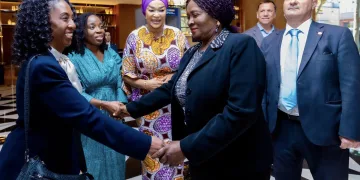
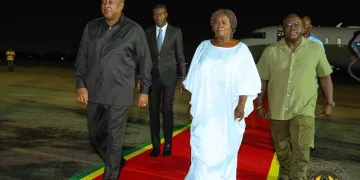
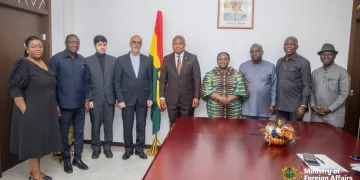
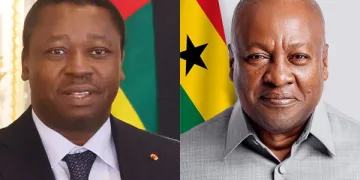
Acting on behalf of the African Union and the entire continent, President John Dramani Mahama last week secured a landmark global recognition of slavery as the gravest crime against humanity.
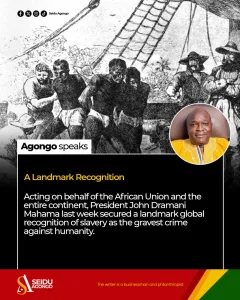
By this, President Mahama and Ghana reminded the world of a truth that had long been buried under silence.
From oral and written history, we have learned of the painful situation where millions of Africans were stolen, broken, and sold.
These enslaved Africans helped to build the present day wealth of Europe and the Americas through their bonded suffering, while Africa was left weak, fractured and hating each other.
In many ways, the recognition, which was voted against by the United States of America, Argentina and Israel matters.
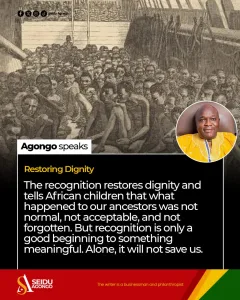
It restores dignity and tells African children that what happened to our ancestors was not normal, not acceptable, and not forgotten.
But like every situation, recognition is only a good beginning to something meaningful. Alone, it will not save us.
Economic dependence
If slavery was the crime of yesterday, then economic dependence is the danger of today.
And unless we act, it could become the shame of tomorrow, haunting our children and bonding their dreams down like the chains used by the slave trades to shackle our ancestors.
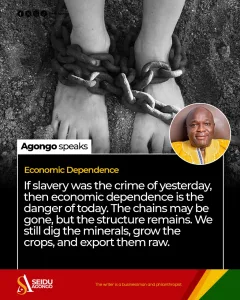
This is more so because the chains may be gone, but the structure remains.
We still dig the minerals, grow the crops, and export them raw. In return, we import finished goods at high prices, calling it trade.
To help normalize and deepen this, many countries have signed duty-free or favourable export terms African nations, the latest being China, allowing our raw materials to be shipped abroad to feed their factories at the expense of our jobs and fragile industries.
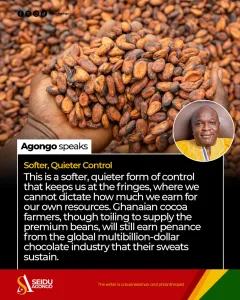
In the business world, this is a softer, quieter form of control that keeps us at the fringes, where we cannot dictate how much we earn for our own resources.
This explains why Ghanaian cocoa farmers, though the people toiling to supply the premium beans, will still earn penance from the global multibillion-dollar chocolate industry that their sweats sustain.
The same applies to gold, bauxite, iron ore, copper, cobalt and lithium, which Africa has vast reserves of.
Harsh but relevant questions
These explain why Ghana’s success at the UN must now mean something at home and across Africa.
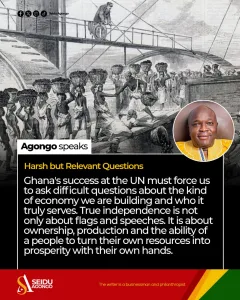
It must force us to ask difficult questions about the kind of economy we are building and who it truly serves.
As has been said in multiple ways, true independence is not only about flags and speeches. It is about ownership, production and the ability of a people to turn their own resources into prosperity with their own hands.
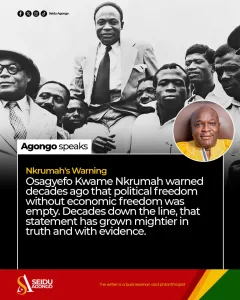
Osagyefo Kwame Nkrumah warned decades ago that political freedom without economic freedom was empty. Decades down the line, that statement has grown mightier in truth and with evidence.
While slavery, colonialism and the global financial architecture have largely worked against African nations, the continent is blessed with innovative and resilient minds, capable of turning of our challenges into business opportunities. A look around you reveals this.
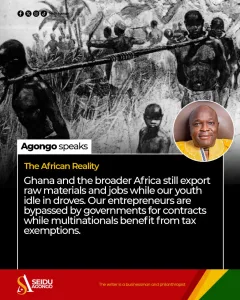
Yet, Ghana and the broader Africa still export raw materials and jobs while our youth idle in droves.
Our entrepreneurs are bypassed by governments for contracts and local businesses endure the full brunt of taxes and general fiscal policies while multinationals, some of them the fruits of slavery and colonialism, benefit from tax exemptions.
While their governments speak for them in high-level meetings with our governments, it only takes demonstrations for the local entrepreneur’s concerns to be felt and heard.
Instructively, Ghana and Africa should be places where local businesses are not treated as afterthoughts.
The continent should be where laws are written to help investors grow, not to permanently favour foreign capital.
Our youth must be supported to dream of building factories and companies, not just chasing foreign visas.
I agree that foreign investment has its place in every nation’s development but evidence abounds that partnership is the winning equation in today’s world.
Partnership involves creating platforms for local and foreign entities to co-create opportunities, share in their respective expertise and grow in ways that respect the uniqueness of one another.
It allows the local entrepreneur to ride on the broad wings of foreign firms to grow while the multinational taps the indigenous expertise to deliver value in-country.
But this cannot be possible under our current policy structure, which literally favours FDIs over local capital.
It requires that our laws change to protect local capital, reward domestic production, and encourage Ghanaians/Africans to take risks and build.
Push for domestic process
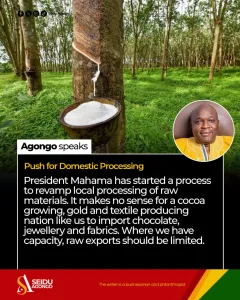
For us in Ghana, it is encouraging to note that President Mahama has started a process to revamp local processing of raw materials.
It makes no sense for a cocoa growing, gold-and textile producing nation like us to import chocolate, jewellery and fabrics.
Over the years, we have made domestic processing an afterthought, suggested to multinationals rather than a policy priority backed by law.
Where we have capacity, raw exports should be limited. Where we lack capacity, government should help build it. Public institutions should buy Ghana made products first.
Ghanaians should be encouraged to consume what they produce.
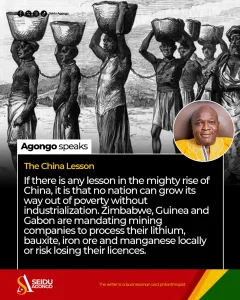
That is why it motivating to hear Zimbabwe, Guinea and Gabon are mandating mining companies to process their lithium, bauxite, iron ore and manganese locally or risk losing their licences.
It is tough route, yes but if there is any lesson in the mighty rise of China, it is that no nation can grow its way out of poverty without industrialization.
It is the surest way to internalizing, be it technically sophisticated processing such as surface one like making toothpicks.
Looking ahead
Thus, as we celebrate the win for our ancestors and our children’s children, we must know that it took as a century to achieve it and it must mean something beyond pride.
It must unite and galvanize us to meaningfully seek and achieve economic sovereignty.
To do that we must unite and rise above party politics.
We must not belong to the NDC or the NPP or whatever party in Africa but belong to Ghana and the broader Africa.
Industrial policies should outlive governments.
National priorities should not change every election cycle for serious nations do not start and abandon economic visions every time a new leader takes over.
As the new scramble for Africa intensifies, this time for our minerals, land and data, we must be interested in who benefits.
We must be sure we are not chaining our wealth and generations away but creating linkages that grow local economies and retain values for communities.
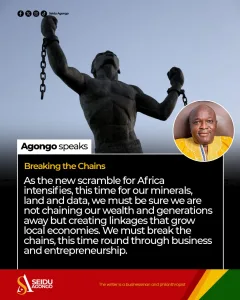
We must break the chains, this time round through business and entrepreneurship.
The writer is a businessman and philanthropist