















































In the first week of June 2026, Ghana’s emergency line broke twice. Not because of fire, but because of fists and stones.
Last Wednesday, June 3, fire tore through Accra Central. Shops burned. Livelihoods went up in smoke. The next day, June 4, two videos told the story of what else burned: public trust.
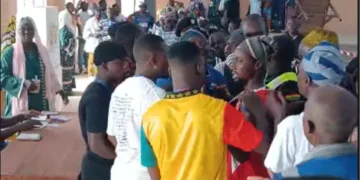
In one, a Ghana National Fire Service officer was raining blows on a delivery rider in Accra. The rider’s offence was that he alleged the fire tenders arrived without water.
In the other, reported from Adubinsu in the Afigya Kwabre South District, firefighters battling a deadly fuel tanker explosion were being pelted with stones and sachet water by residents. DOII Atta Aheng Mensah, the Ashanti Regional PRO, said elders had to calm the youth before the crew could work.
Two scenes. One week. One disease. We have turned emergency grounds into battlegrounds.
Let’s dispense with sides and deal with facts. The Accra rider was wrong. In a crisis, false claims spread like flames. Accusing firefighters of coming empty-handed, without proof, is reckless. It demoralizes crews and misleads the public.
The Adubinsu residents were wrong. Stoning firefighters during a tanker explosion is not grief. It is obstruction. You do not attack the people trying to keep your community from becoming a crater.
And the Accra fire officer was wrong. His response to a verbal claim was not correction, not education, not arrest. It was punishment with his fists. He struck a civilian in the stomach, in full uniform, on camera, while his colleagues had to pull him off.
That is the pattern we must break. Citizens feel entitled to assault firefighters. Some firefighters feel entitled to assault citizens. Both impulses come from the same place: the belief that anger is a licence to violence.
But the law does not see them as equal, and neither should we. When a civilian throws a stone, it is a crime. When an officer throws a punch, it is a breach of the state’s contract with its people. The state holds a monopoly on force. That means it holds a monopoly on restraint. You cannot ask citizens to respect the uniform when the uniform refuses to respect the citizen.
What happened in Accra was not firefighting. It was lawlessness in a helmet. The rider was not a thief. He was not armed. He was not resisting arrest. He was a citizen with a mouth, and in Ghana that is not a capital offence. We have courts for allegations. We have due process for lies. We do not have a penal code that says beatings by the roadside.
What happened in Adubinsu was not frustration. It was attempted harm. You do not get to endanger the lives of responders because you are angry at a fire. The job of a citizen is to allow professionals to work, not to stone them.
This is the rot we have normalized from both ends. If citizens cannot question, even wrongly, without fearing a beating, then we are not a Republic. We are a barracks. If firefighters cannot do their job without dodging stones, then we are not a society. We are a mob.
So the Ghana National Fire Service owes the public action, not appeals. Apologize directly to the Accra rider. Suspend and investigate the officer involved. Prosecute the civilians who attacked the crew at Adubinsu. Retrain personnel on crowd engagement and run public education on civilian conduct at emergency scenes. Fires draw crowds. Crowds talk. Some will be ignorant. Some will be angry. The job of a professional is to manage that, not to punch it. The job of a citizen is to let them work, not to obstruct them.
And to the rest of us, we must condemn the false claim, the stone pelting, and the assault in the same breath. Defending one wrong because you hate the other is how a society loses its moral compass.
The June 3 fire destroyed goods. The June 4 beating and the June 4 stoning damaged something worse: the rule that says we solve crises with law, not violence. Goods can be replaced. Trust, once burned from both ends, takes a generation to rebuild.
Last week the Fire Service was called to put out fires. Twice, new ones were lit, once by a man in uniform, once by a crowd without one.
We cannot afford either.