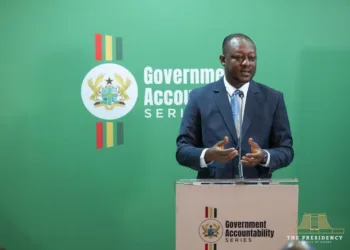








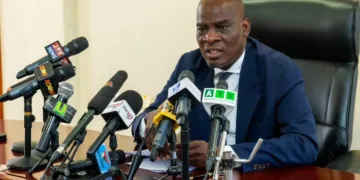















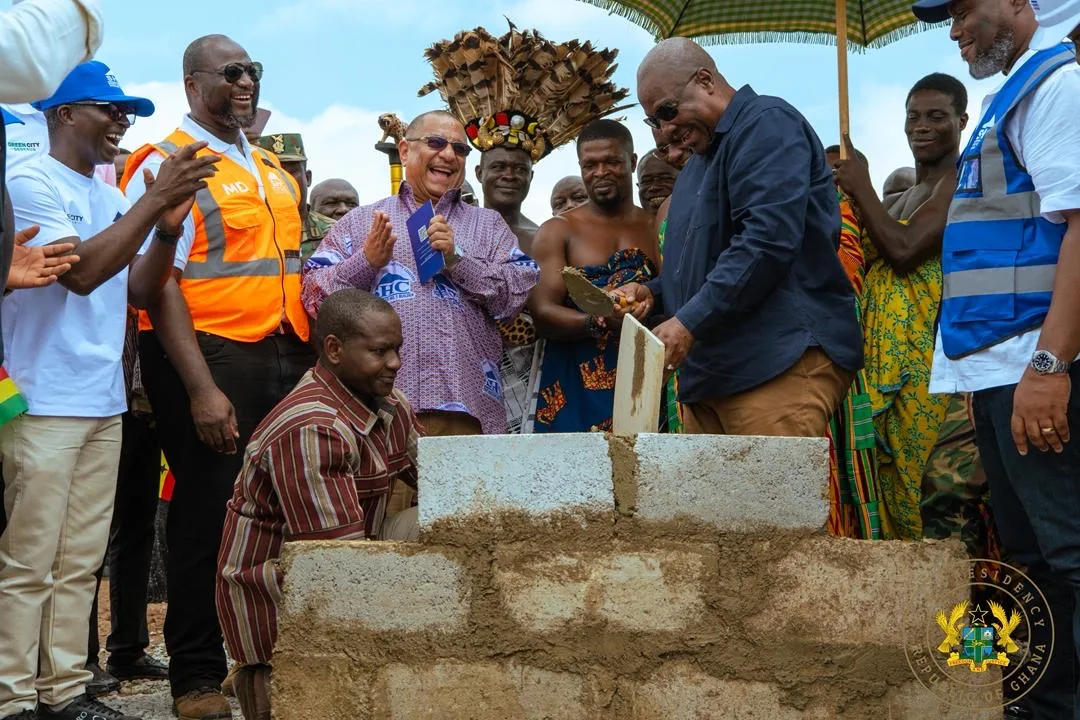
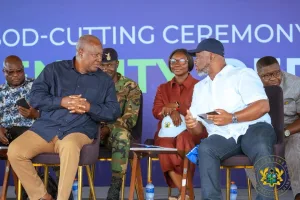
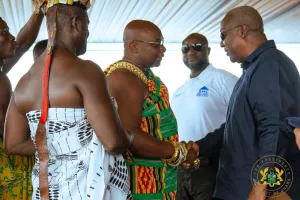
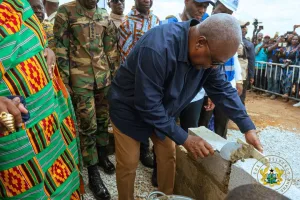
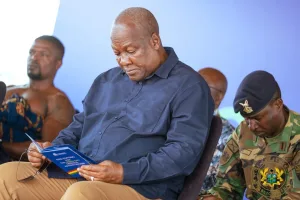
President John Dramani Mahama has cut the sod for the Green City Housing Project in the Ashanti Region, as part of efforts to address Ghana’s growing housing deficit and respond to rapid urbanisation pressures in major cities.
Speaking during the sod-cutting ceremony at Dedesua in the Ashanti Region on Saturday, May 9, 2026, President John Dramani Mahama described the project as a historic moment in Ghana’s housing development journey and a response to the country’s urgent housing challenges.
“It is a singular honour for me to be here this morning to stand on this historic ground to cut sod for the Green City Housing Project and to mark the start of a new phase in Ghana’s long and evolving housing journey,” he said.
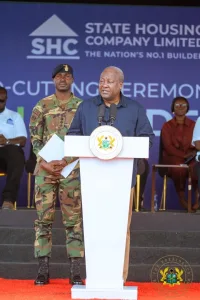
He explained that Ghana’s housing challenge is becoming more severe due to rapid urbanisation and rising demand for homes in major cities.
“Today more than half of the population of Ghana lives in urban areas and projections indicate that this could rise to about 70% by 2050,” he stated.
“Cities such as Accra, Kumasi and Takoradi will continue to grow rapidly and will be swamped by migration from other parts of the country. If we do not act urgently and at scale, tomorrow’s housing crisis will far exceed what we are experiencing today.”
The President said the housing deficit, estimated at over 1.5 million units, reflects years of supply not meeting demand, worsened by high land prices and limited access to affordable financing.
“The result is clear: informal settlements continue to expand, slums are growing, and too many of our people are living in substandard conditions,” he said.
He stressed that government’s housing reset agenda is focused on changing how housing is delivered in Ghana.
“Our reset agenda is not just a slogan. It is a commitment to rethink how we deliver housing, infrastructure and opportunity for our people,” he said.
“At the heart of this vision is the belief that decent housing is not a privilege for a few, but a right for all our people.”
President Mahama also highlighted the importance of housing to national development.
“Access to housing improves public health, strengthens educational outcomes, boosts productivity and stabilises communities,” he noted.
“A nation that is seeking development must house its people with dignity.”
He confirmed that the Green City Housing Project is part of a wider national housing programme that includes the completion of the Saglemi Affordable Housing Project, district-level social housing schemes, and a new financing model to improve affordability.
“The Saglemi affordable housing project, which was begun in the previous term of the NDC, is being prioritised for completion,” he said.
“New social housing initiatives at the district level are also being rolled out to reduce financial barriers to ownership.”
He further announced a partnership-based financing framework aimed at making housing more accessible to workers.
“A three billion revolving housing fund will be created in partnership with government, organised labour and financial institutions,” he explained.
“This will enable workers to acquire homes with manageable long-term repayments.”
President Mahama also confirmed that housing under the new scheme will be priced in Ghana cedis to protect buyers from currency fluctuations.
“These houses are going to be indexed in cedis, not dollars,” he said.
“This will ensure stability in mortgage repayments and make home ownership more predictable for Ghanaian workers.”
He added that the Green City project will also promote fairness in the rental sector and expand access to decent housing across the country.
“Housing must not be limited to major cities. Regional and district capitals must also benefit,” he said.
The Green City Housing Project is expected to deliver over 1,000 housing units within a modern, integrated community, with supporting infrastructure and job creation opportunities for residents in the Ashanti Region.
Source: Mubarak Yakubu