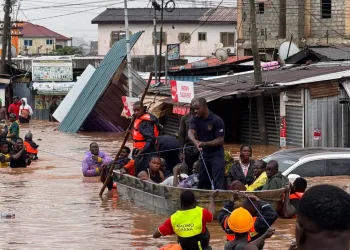

















Every year, the rains come. Every year, communities flood. Every year, we count the losses, mourn the dead, and ask the same question: Why does this keep happening?
Recent commentaries have argued that the cancellation of the YEA–Zoomlion sanitation contract has contributed to deteriorating sanitation and increased flooding by reducing organized drain desilting and street cleaning efforts.
Whether one agrees with that conclusion or not, the debate raises an important question: Can Ghana continue to depend primarily on contracts to solve what is fundamentally a societal problem?
The reality is that flooding in Ghana did not begin with the cancellation of one contract, nor will it end with the signing of another.
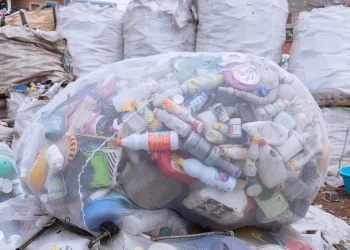
Flooding is the result of multiple interconnected challenges: poor waste disposal, blocked drains, weak enforcement of planning regulations, settlements on waterways, rapid urbanisation, and increasingly intense rainfall.
These are problems that require effective government institutions, but they also require responsible citizens.
Perhaps the solution we need is not another sanitation contract.
Perhaps what Ghana needs is a national culture of collective responsibility.
This is where Rwanda offers a lesson worth studying.
For decades, Rwanda has institutionalised Umuganda, a nationwide community service programme that takes place on the last Saturday of every month.
The word Umuganda comes from the Kinyarwanda language and refers to “coming together in common purpose to achieve a shared goal.”
On Umuganda day, citizens between the ages of 18 and 65 are expected to participate in community service.
Roads are repaired, drainage channels are cleared, public spaces are cleaned, trees are planted, schools and health facilities are maintained, and vulnerable members of the community are supported.
What makes Umuganda remarkable is that it is more than a clean-up exercise. After the physical work, community members gather with local leaders to discuss issues affecting their neighbourhoods, review progress on community projects, and collectively identify solutions to local challenges.
It is a practical demonstration of active citizenship, where development is seen not only as the responsibility of government but also as the shared responsibility of every citizen.
The result is not merely cleaner streets.
Umuganda has strengthened social cohesion, promoted environmental stewardship, encouraged civic participation, and reinforced the belief that sustainable development begins with communities taking ownership of their own environment.
Imagine what Ghana could achieve if, on the last Saturday of every month, every community dedicated just three hours to collective service.
Imagine youth groups clearing drains before the rainy season.
Imagine residents taking ownership of their neighbourhoods instead of waiting for contractors.
Imagine local assemblies working alongside citizens instead of working for citizens.
Such a system would not replace government. Government would still be responsible for constructing drainage infrastructure, enforcing building regulations, improving waste management systems, and investing in flood resilience.
But citizens would become active partners rather than passive observers.
This is the sustainable path.
No contractor, regardless of its capacity, can be present in every community every day.
No government can monitor every drain or stop every act of indiscriminate waste disposal without public cooperation.
Sustainable sanitation begins with changing attitudes and beliefs.
Young people, in particular, have a critical role to play.
Rather than seeing flooding as an inevitable seasonal disaster or solely the responsibility of government, they can become champions of environmental responsibility, mobilizing their schools, churches, mosques, neighbourhoods, and social networks to protect their communities.
Ghana has a proud history of communal labour.
Long before modern sanitation systems, communities came together to maintain roads, clean public spaces, build schools, and support one another.
We have not lost that spirit—we have simply allowed it to fade.
Reviving that tradition does not require reinventing the wheel.
It requires adapting proven ideas to our own context. Ghana can learn from Rwanda’s experience while designing a uniquely Ghanaian model that reflects our culture, values, and traditions.
Rather than asking whether one contract should return or another should replace it, we should be asking a bigger question: How do we build a nation where every citizen feels personally responsible for the cleanliness and safety of their community?
That conversation may ultimately prove far more important than any procurement decision.
Our fight against flooding will not be won only in Parliament or in government offices.
It will be won in our homes, our schools, our markets, our churches, and on our streets—when every Ghanaian embraces the simple but powerful principle that clean communities are a shared responsibility.
Perhaps the lasting solution to Ghana’s flooding challenge lies not only in sanitation contracts but also in building our own version of Umuganda—a national movement that transforms communal labour from an occasional activity into a way of life.
When citizens and government work as genuine partners in protecting their communities, we will not only reduce flooding but also build stronger, healthier, and more resilient communities for generations to come.
The writer is an Epidemiologist | CEO, Ghana Health Improvement Access Network