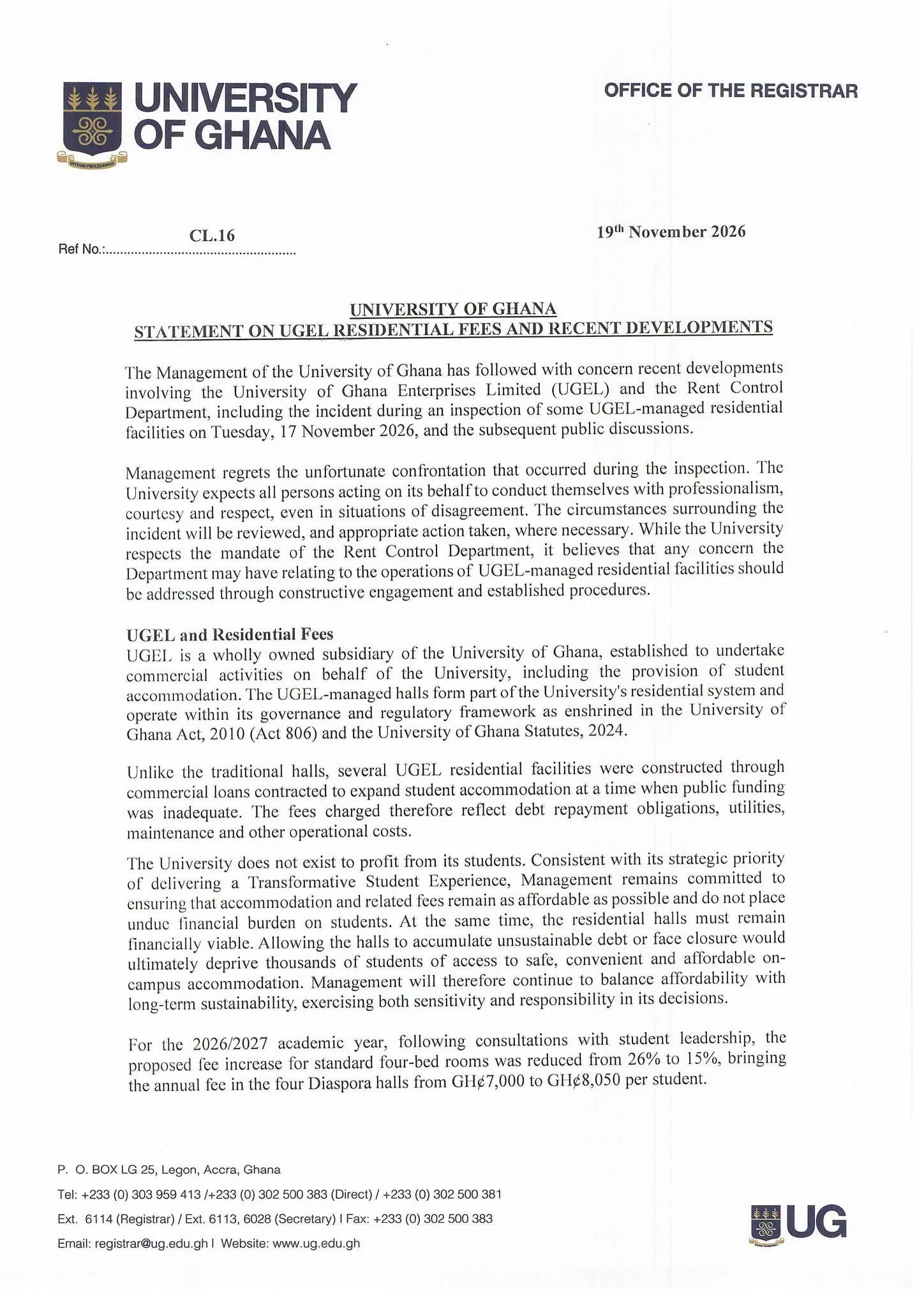

























































The Management of the University of Ghana has issued a statement on residential fees charged by the University of Ghana Enterprises Limited (UGEL) and recent developments involving the Rent Control Department, following an incident during an inspection of some UGEL-managed residential facilities on Tuesday, 17 November 2026.
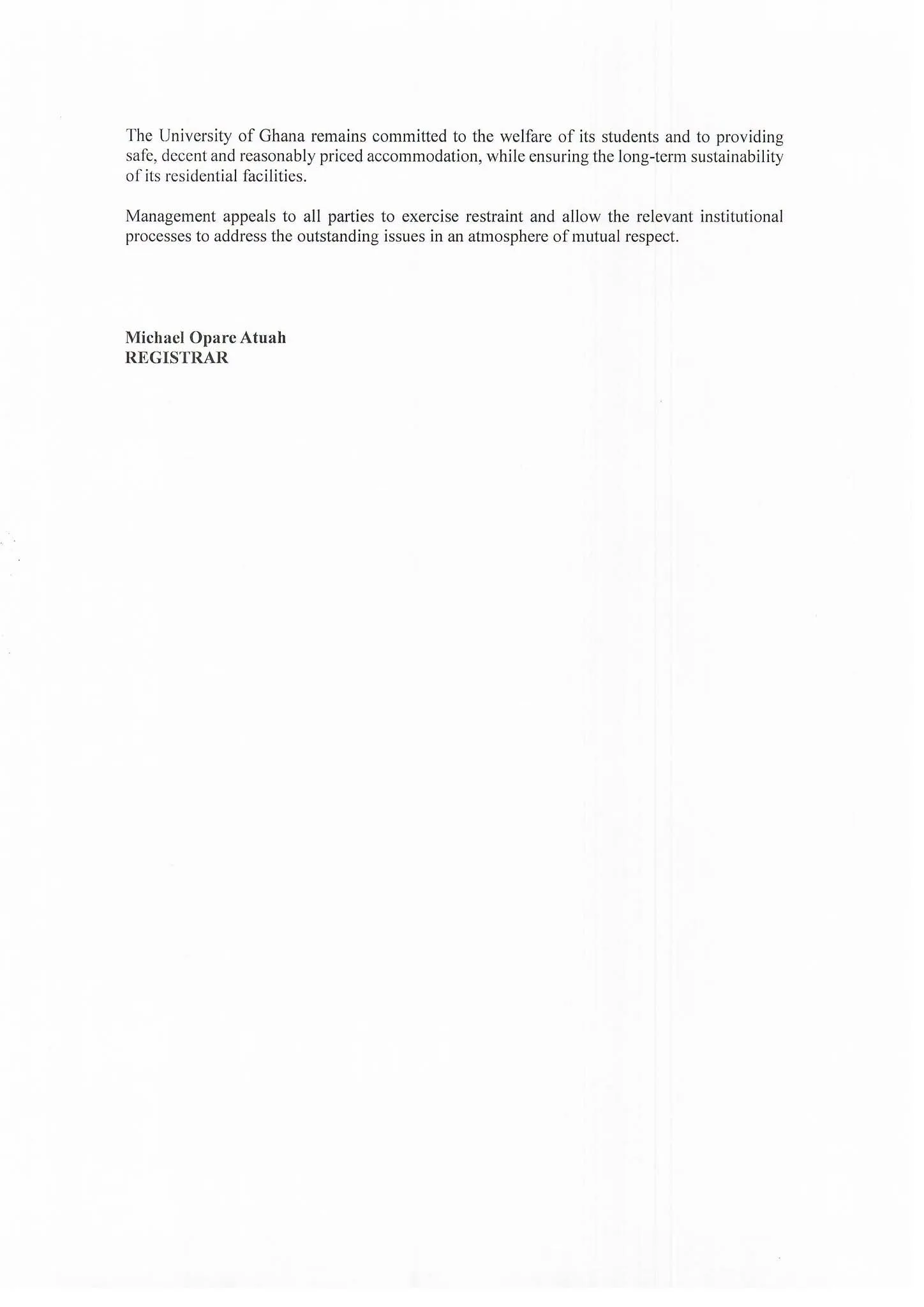
In a statement dated 19th November 2026 and signed by the Registrar, Michael Opare Atuah, Management said it had followed with concern the recent developments and subsequent public discussions.
Management expressed regret over the unfortunate confrontation that occurred during the inspection, stressing that the University expects all persons acting on its behalf to conduct themselves with professionalism, courtesy and respect, even in situations of disagreement.
“The circumstances surrounding the incident will be reviewed, and appropriate action taken, where necessary,” the statement said.
It added that while the University respects the mandate of the Rent Control Department, it believes any concern the Department may have relating to the operations of UGEL-managed residential facilities should be addressed through constructive engagement and established procedures.
According to the statement, UGEL is a wholly owned subsidiary of the University of Ghana, established to undertake commercial activities on behalf of the University, including the provision of student accommodation.
The UGEL-managed halls form part of the University’s residential system and operate within its governance and regulatory framework as enshrined in the University of Ghana Act, 2010 (Act 806) and the University of Ghana Statutes, 2024.
Management explained that unlike the traditional halls, several UGEL residential facilities were constructed through commercial loans contracted to expand student accommodation at a time when public funding was inadequate.
“The fees charged therefore reflect debt repayment obligations, utilities, maintenance and other operational costs,” the statement noted.
It stressed that the University does not exist to profit from its students, and remains committed to ensuring that accommodation and related fees remain as affordable as possible and do not place undue financial burden on students.
At the same time, Management said the residential halls must remain financially viable, warning that allowing the halls to accumulate unsustainable debt or face closure would ultimately deprive thousands of students of access to safe, convenient and affordable on-campus accommodation.
For the 2026/2027 academic year, following consultations with student leadership, the proposed fee increase for standard four-bed rooms was reduced from 26% to 15%, bringing the annual fee in the four Diaspora halls from GH¢7,000 to GH¢8,050 per student.
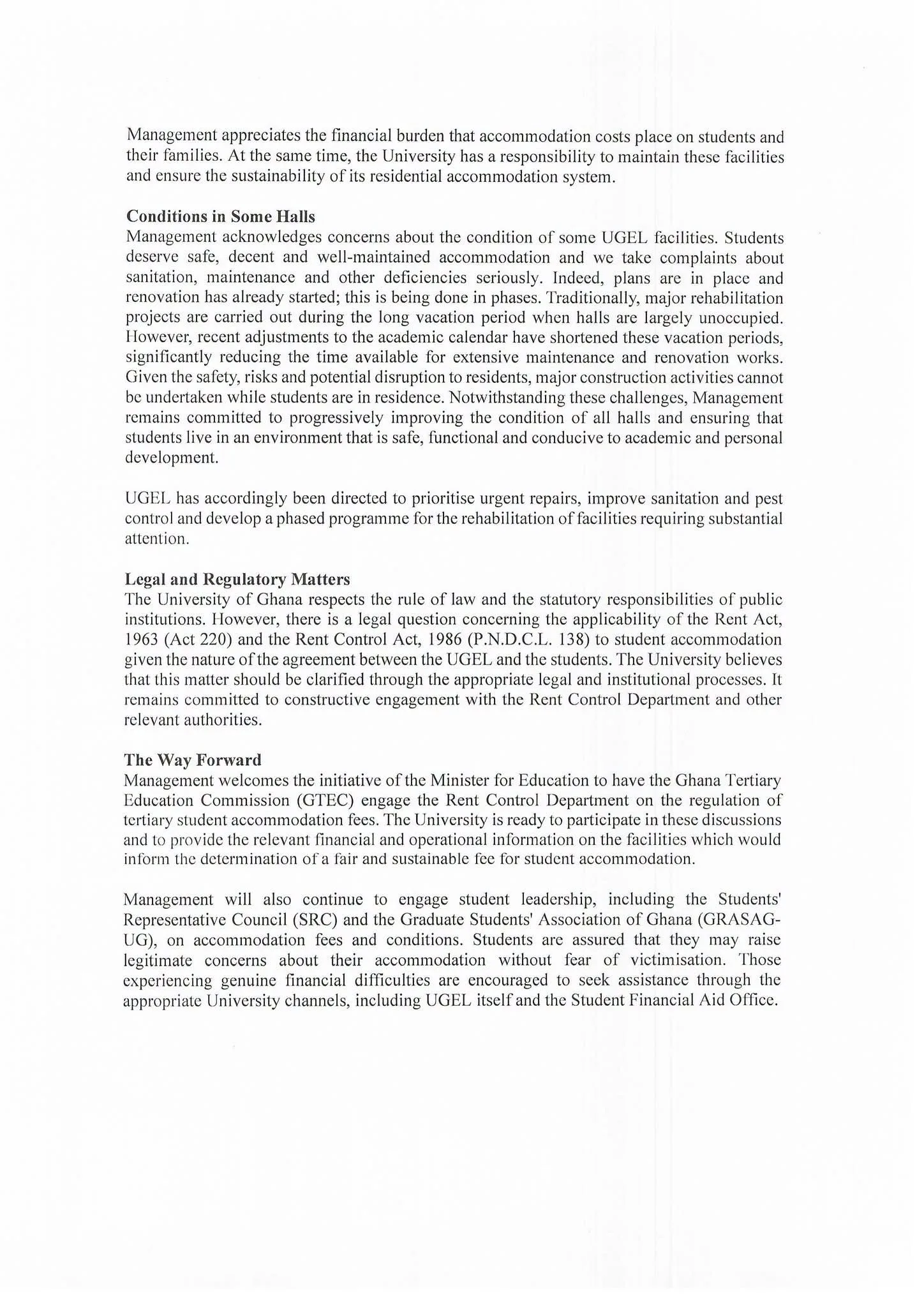
Management said it appreciates the financial burden accommodation costs place on students and their families, but has a responsibility to maintain the facilities and ensure the sustainability of its residential accommodation system.
Management acknowledged concerns about the condition of some UGEL facilities, saying students deserve safe, decent and well-maintained accommodation and that complaints about sanitation, maintenance and other deficiencies are taken seriously.
It said plans are in place and renovation has already started, being done in phases. Traditionally, major rehabilitation projects are carried out during long vacation periods when halls are largely unoccupied.
However, recent adjustments to the academic calendar have shortened these vacation periods, significantly reducing the time available for extensive maintenance and renovation works.
Given safety, risks and potential disruption to residents, Management said major construction activities cannot be undertaken while students are in residence.
“Notwithstanding these challenges, Management remains committed to progressively improving the condition of all halls and ensuring that students live in an environment that is safe, functional and conducive to academic and personal development,” it said.
UGEL has accordingly been directed to prioritise urgent repairs, improve sanitation and pest control and develop a phased programme for the rehabilitation of facilities requiring substantial attention.
On the legal issues, the University said it respects the rule of law and the statutory responsibilities of public institutions.
However, it noted that there is a legal question concerning the applicability of the Rent Act, 1963 (Act 220) and the Rent Control Act, 1986 (P.N.D.C.L. 138) to student accommodation given the nature of the agreement between UGEL and the students.
“The University believes that this matter should be clarified through the appropriate legal and institutional processes,” the statement said, adding that it remains committed to constructive engagement with the Rent Control Department and other relevant authorities.
Management welcomed the initiative of the Minister for Education to have the Ghana Tertiary Education Commission (GTEC) engage the Rent Control Department on the regulation of tertiary student accommodation fees.
It said the University is ready to participate in the discussions and to provide the relevant financial and operational information on the facilities, which would inform the determination of a fair and sustainable fee for student accommodation.
Management also said it will continue to engage student leadership, including the Students’ Representative Council (SRC) and the Graduate Students’ Association of Ghana (GRASAG-UG), on accommodation fees and conditions.
Students were assured that they may raise legitimate concerns about their accommodation without fear of victimisation. Those experiencing genuine financial difficulties were encouraged to seek assistance through the appropriate University channels, including UGEL itself and the Student Financial Aid Office.
“The University of Ghana remains committed to the welfare of its students and to providing safe, decent and reasonably priced accommodation, while ensuring the long-term sustainability of its residential facilities,” the statement concluded.
Management appealed to all parties to exercise restraint and allow the relevant institutional processes to address the outstanding issues in an atmosphere of mutual respect.