


















































Economic activities in parts of the Volta Region, particularly the North, Central and South Tongu districts, as well as Ketu North and South, are reportedly grinding to a halt following recent operations by the National Anti-Illegal Mining Operations Secretariat (NAIMOS) against local sand winners.
The operations, which involved the destruction of equipment and the arrest of some operators, have disrupted an economic activity that has provided employment and income for several residents in the affected communities over the years.
Several petty trading businesses that depend on the activities of sand winners for their daily sales are also said to have been affected, with some traders and residents accusing their Members of Parliament (MPs) and other political leaders of abandoning them in their moment of need.
The residents expressed disappointment over what they described as the deafening silence of their political representatives, arguing that the same leaders would have been more vocal had the situation occurred under the erstwhile New Patriotic Party (NPP) administration.
According to them, they were particularly aggrieved that the use of military force against them was taking place under a government they had fought and made sacrifices to bring into power.
They warned that failure to urgently address the concerns of local sand winners and affected communities could fuel public dissatisfaction, voter apathy and broader political consequences for the governing NDC ahead of the 2028 general elections.
They are appealing to the MPs for the affected constituencies, Alexander Roosevelt Hottordze (Central Tongu), Maxwell Kwamé Lukutor (South Tongu), Samuel Okudzeto Ablakwa (North Tongu), Eric Edem Agbana (Ketu North) and Dzifa Abla Gomashie (Ketu South), as well as traditional authorities, to intervene and engage the relevant authorities to resolve the situation.
NDC Chairman Questions NAIMOS
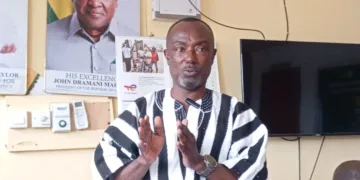
Meanwhile, former Central Tongu Constituency Chairman of the National Democratic Congress (NDC), Confidence Abotsi, has criticised the handling of the crackdown, insisting that although enforcing regulations against illegal activities is necessary, the government must consider the economic consequences for affected communities.
Speaking to the Ghana News Agency (GNA), he argued that the operations should be accompanied by alternative livelihood arrangements to prevent residents who depend on sand winning from being plunged into economic hardship.
According to him, sand winning has been an established economic activity in the North, Central and South Tongu districts for several years, providing employment for residents and contributing to revenue mobilisation by the respective Municipal and District Assemblies.
He further argued that local operators had contributed to the desilting of the Volta River bed through their activities, questioning the rationale for halting their operations while a private company had reportedly been contracted by the government to undertake similar work for a fee.
Mr Abotsi alleged that a company identified as JSC Meridianaan, with the support of NAIMOS and security personnel, had effectively taken over the activity, resulting in the destruction of equipment belonging to local operators and restricting their participation in the business.
He warned that the arrangement could create a monopoly in the sector, leaving indigenous operators without their sources of livelihood while a private entity benefits from a government-backed desilting programme.
The former constituency chairman also questioned whether NAIMOS’s mandate extended to all sand-winning activities, including those undertaken by operators reportedly recognised by local authorities and paying fees to the respective Assemblies.
He called for greater clarity on the regulatory framework governing sand winning in the area, arguing that operators whose activities are considered illegal or irregular should, where possible, be given the opportunity to regularise their operations.
Mr Abotsi maintained that the government’s efforts to formalise economic activities, including small-scale mining, should also guide its approach to local sand winning, particularly given the sector’s contribution to employment and household incomes.
Political Consequences
Beyond the economic implications, Mr Abotsi warned that the situation could breed resentment among residents and deepen political apathy in the Tongu enclave if their concerns were not urgently addressed.
He disclosed that he had already communicated the concerns to the NDC General Secretary, Fiifi Fiavi Kwetey; National Chairman, Johnson Asiedu Nketia; Volta Regional Minister, James Gunu; and the President’s Volta Regional Political Coordinator, Siki Abebu.
He urged the government and relevant security agencies to adopt an approach that balances environmental protection and regulatory enforcement with the need to preserve legitimate economic activities and employment opportunities.
Mr Abotsi cautioned that failure to address the concerns of affected communities could deepen public dissatisfaction and carry wider political consequences for the governing NDC ahead of the 2028 general elections.
He reiterated his support for local sand winners and called for constructive engagement among the government, security agencies, traditional authorities, local assemblies and affected operators to find a sustainable solution.
Credit: The Archives