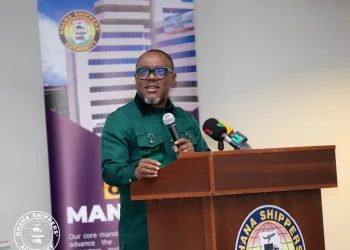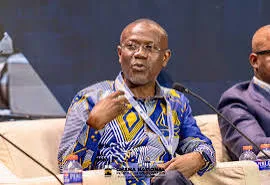

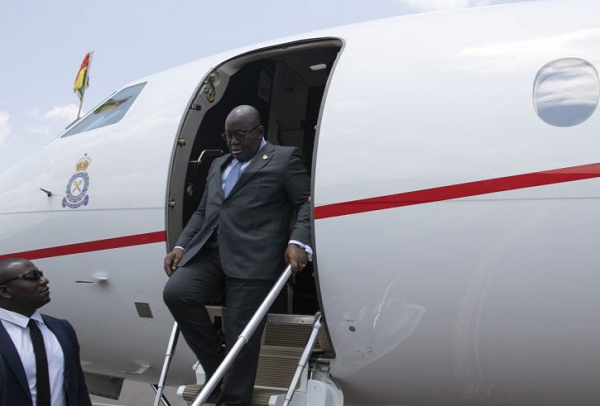


























































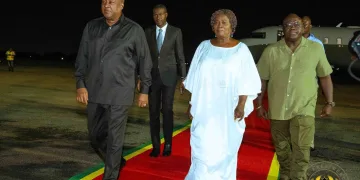


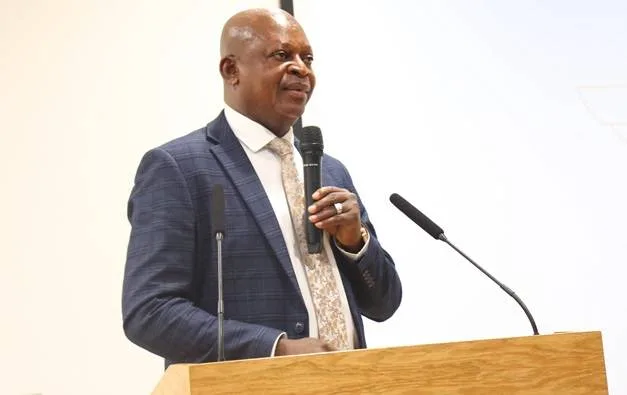
The Minister for Transport, Joseph Bukari Nikpe, has warned that Ghana risks losing transit trade to competing routes if its transport corridors become unnecessarily expensive, unpredictable or inefficient.
The Minister gave the caution at the official launch of the National Non Tariff Barriers (NTB) Reporting and Resolution Platform at the Labadi Beach Hotel in Accra on Thursday, November 26, 2026, where he argued that Ghana must compete on the quality of its logistics services, not only on its location.
Speaking at the launch, the Minister noted that landlocked countries in the subregion have alternative routes for their cargo, and Ghana cannot take their business for granted.
“If our corridors become unnecessarily expensive, unpredictable or inefficient, that business can move elsewhere,” he warned.
“Ghana must compete not merely on geography, but on the quality, efficiency and reliability of the transport and logistics services it offers,” he added.
According to the Minister, Ghana’s competitiveness is determined not simply by where goods enter the country, but by how efficiently they move from ports, through transport corridors and across borders to their final destinations.
He disclosed that in 2025, Ghana’s ports handled approximately 31.08 million metric tonnes of cargo, including about 1.26 million metric tonnes of combined transit and transshipment cargo, with Tema and Takoradi serving as critical gateways for international commerce and transit trade within the West African subregion.
He observed that while those figures show the strategic importance of the maritime sector, port performance alone cannot define the competitiveness of the transport system.
He explained that the benefits of investments in port infrastructure and cargo handling capacity can only be fully realized when goods move efficiently beyond the port gates, along road and rail networks, through inland logistics facilities and across borders.
The Minister listed some of the persistent challenges facing transport operators, including multiple checkpoints, delays, inconsistent enforcement of axle load regulations, poor road conditions and inadequate supporting facilities along some corridors.
He pointed out that at ports and borders, administrative delays, uncoordinated inspections and inconsistent regulatory practices can further increase the time and cost of moving cargo.
These challenges, he stressed, increase the cost of doing business, undermine the competitiveness of transport operators and affect the attractiveness of Ghana as a preferred gateway for regional trade.
He maintained that it is against this background that the NTB Platform assumes particular importance, because it gives traders, shippers, freight forwarders, transport operators, importers and exporters an accessible channel to report barriers encountered in the movement of goods.
He further explained that the platform also provides an institutional framework for receiving, referring, tracking and addressing these reports, thereby strengthening coordination among the agencies responsible for facilitating trade.
For the Ministry of Transport, he noted, the reports can provide valuable evidence of recurring challenges affecting ports, shipping services, road transport operations and transit corridors.
Rather than relying solely on isolated complaints or anecdotal accounts, he added, government will now have an opportunity to identify persistent bottlenecks, understand their causes and work with the relevant institutions towards practical solutions.
“The success of this platform will not be measured by the number of complaints received, but by the number of barriers effectively resolved,” the Minister emphasised.
He cautioned that a reporting mechanism that merely records complaints without producing corrective action will fall short of its purpose, and charged participating institutions to treat reports with urgency.
He insisted that institutional focal persons must take ownership of their responsibilities, and agencies must demonstrate a clear commitment to accountability and results.
“Our objective must be to move from reporting barriers to removing them,” he stated.
The Minister reaffirmed that the Ministry of Transport remains committed to working with the Ministry of Trade, Agribusiness and Industry, the Ghana Shippers Authority, the Ghana Ports and Harbours Authority, the Ghana Maritime Authority, the Ghana Revenue Authority and other relevant institutions to build a more integrated, efficient and responsive transport and logistics system.
He outlined that this includes strengthening connectivity between ports and inland markets, improving cargo evacuation, promoting multimodal transport and developing the logistics infrastructure required to support the movement of goods, including initiatives such as the Boankra Integrated Logistics Terminal.
“Trade agreements alone cannot deliver regional integration, because their benefits depend on the ability to move goods across borders with fewer delays, lower costs and greater predictability,” he argued.
He commended the Ghana Shippers Authority, the Ministry of Trade, Agribusiness and Industry, TradeMark Africa and STAMES for their collaboration in developing the initiative.
He also encouraged the private sector, particularly shipping lines, freight forwarders, haulage companies, importers and exporters, to actively use the platform, saying their experiences are essential to identifying barriers and providing the evidence needed to address them.
“Government institutions must respond, the private sector must report, and all stakeholders must remain committed to finding lasting solutions,” he urged.
He ended by saying Ghana’s ambition must be to build a transport and logistics system that makes the country not only a strategic location for trade, but a preferred and reliable gateway for the movement of goods across West Africa.