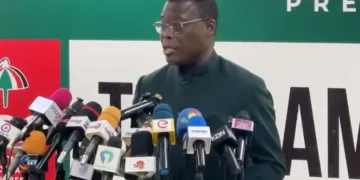
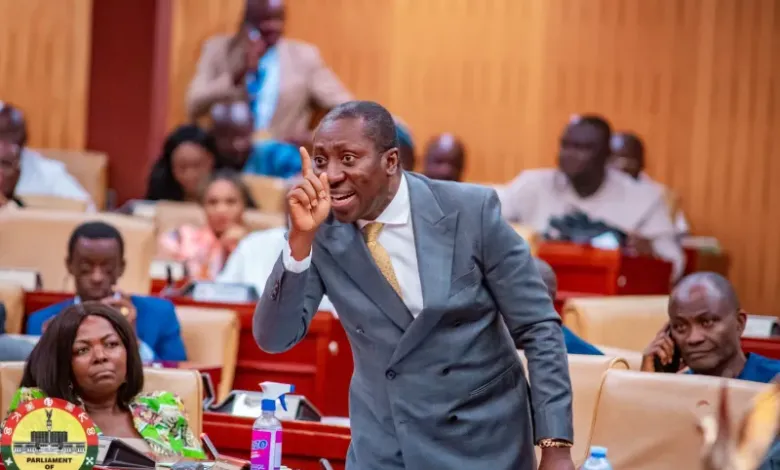

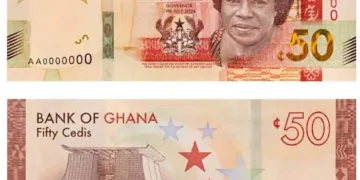

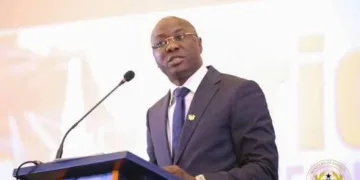

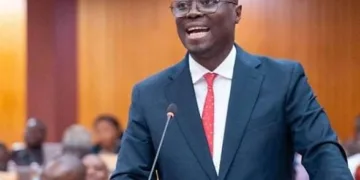








The Minority Leader in Parliament, Alexander Afenyo-Markin, has criticised the government over the unveiling of new banknotes that remove the collective portrait of the Big Six, retaining only Dr. Kwame Nkrumah.
In a post on his Facebook page, Afenyo-Markin said the move, which comes as Ghana approaches its 70th Independence Anniversary, sends a troubling message about how the country chooses to remember its national struggle.
“Your government can remove the Big Six from the currency, but can never withdraw them from history,” he wrote.
He argued that the NPP did not invent the Big Six, noting that their place in history arose from their organised leadership in the struggle for independence and specifically, the detention of six United Gold Coast Convention (UGCC) leaders following the 1948 disturbances.
According to him, the Convention People’s Party (CPP) itself emerged from the UGCC in 1949.
“You cannot celebrate the fruit while pretending the tree never existed,” he said.
Afenyo-Markin recalled that after the disturbances, the Watson Commission investigated their causes and examined the role of the UGCC and its detained leaders, followed by the Coussey constitutional process and reforms towards independence.
He said these events were recorded decades before either the New Patriotic Party (NPP) or the National Democratic Congress (NDC) existed.
He also pointed to Dr. Nkrumah’s own autobiography, where he acknowledged the group: “The ‘Big Six’, as we came to be known,” and went on to mention the other five by name.
“Perhaps this government’s historians should summon Nkrumah for questioning!” he added.
The Minority Leader noted that the Big Six appeared together on the redenominated banknotes introduced in 2007 under President Kufuor and Governor Paul Acquah, during Ghana’s Golden Jubilee year.
“It was not President Akufo-Addo who put them there. He did not decree three of his family members to be part of the Big Six. He was only four years old when the 1948 riots took place,” he said.
He further pointed out that under President Mills, a known Nkrumahist, the GH¢2 note was introduced bearing Nkrumah’s portrait alone, while the other notes retained the Big Six.
“No fuss. That was a straightforward demonstration that we could honour an individual without removing his colleagues,” he stated.
While welcoming recognition for Theodosia Salome Okoh, Ephraim Amu, Kofi Annan and other distinguished Ghanaians, Afenyo-Markin questioned why honouring more patriots must require removing others.
“Is there a shortage of space on our currency, or a shortage of tolerance for the parts of our history that celebrate patriots the Mahama-led NDC does not like?” he asked.
He said the CPP, the ruling party at independence, had its roots in the UGCC, and that the NDC, from its inception, also drew considerable support from the CPP’s political constituency, illustrating what he described as a shared political history.
Afenyo-Markin said Ghana’s history extends beyond the Big Six, citing Chief Simon Diedong Dombo, whom he described as a teacher, traditional ruler, parliamentarian and leading voice for Northern Ghana.
He said under Dombo’s leadership, the Northern People’s Party won 15 seats in the 1956 election, giving northern interests a powerful voice during the constitutional debates preceding independence.
He added that Dombo subsequently helped bring regional opposition parties together into the United Party, stood for political pluralism and endured detention under Nkrumah’s government.
“If the purpose is to broaden national recognition, Dombo deserves consideration too,” he said.
He also mentioned Otumfuo Sir Osei Agyeman Prempeh II, whose cooperation with J. B. Danquah, he said, helped bring Asante and the Colony into a common constitutional framework, first under the Burns Constitution in 1946, under Governor Sir Alan Burns, which brought Asante and the Gold Coast Colony into a common Legislative Council, with an African majority for the first time.
On Theodosia Okoh, Afenyo-Markin noted what he called an irony in the present celebration of her, recalling that in 1964, the CPP government replaced the National Flag with the party flag, removing the gold stripe in her national flag and replacing it with white, giving it the CPP’s red, white and green colours. Her original design was restored in 1966 after Nkrumah’s overthrow.
He also raised the controversy over her portrait on the new notes, noting that her nephew, Dr. Eddie Obeng, says the image resembles his mother, Dr. Letitia Obeng, rather than his aunt, while the Bank of Ghana disputes this and says it used photographs of Mrs. Okoh.
“The sensible response is to publish the source photographs and resolve the matter transparently with the family. But we doubt very much if the Bank knows her better than her own family. If a correction is required, admit it and make it. The woman who gave Ghana its unmistakable flag deserves an unmistakable portrait,” he said.
He further criticised the government for being unwilling to recognise J. B. Danquah, who he said proposed the name Ghana for an independent Gold Coast.
“It is sad that the Mahama-led NDC government does not want to acknowledge J. B. Danquah, whose research and advocacy helped advance the adoption of the name Ghana. His campaign convinced colleagues within the UGCC and the wider nationalist movement. Nkrumah’s government adopted that name despite their political differences,” he stated.
Afenyo-Markin called on President John Dramani Mahama to rise above what he described as the temptation to make national recognition an exercise in partisan selection.
“Our currency belongs to every Ghanaian. It should reflect the breadth of our history and the generosity of our national spirit.
“Honour more of our patriots. Teach their achievements. Debate their differences. Give the next generation the full story,” he added.