













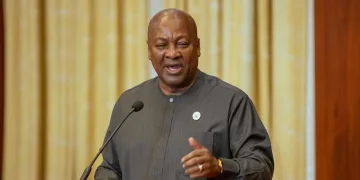

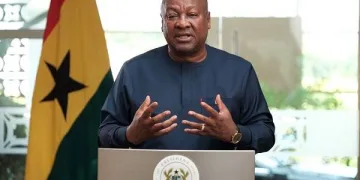





























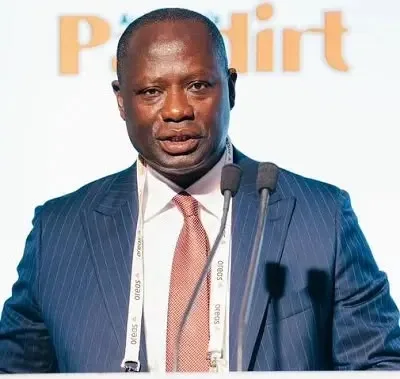
The Minister of Lands and Natural Resources, Emmanuel Armah-Kofi Buah, has announced that Ghana is expected to rake in approximately US$68 million from the sale of 6.5 million verified forest carbon credits.
He described the development as a major breakthrough in the country’s climate financing drive, making Ghana the first African nation and the third globally, after Guyana and Costa Rica, to secure the issuance of jurisdictional forest carbon credits under the Architecture for REDD+ Transactions (ART) standard.
According to the Ghanaian Times newspaper monitored by Angelonline on Tuesday November 24, Mr. Buah said the ART Board approved the issuance on November 10, 2026, following an independent assessment and verification of Ghana’s forest carbon performance when he addressed the media in Accra.
“Ghana has made history as the first country in Africa and the third in the world, after Guyana and Costa Rica, to achieve the issuance of jurisdictional forest carbon credits under the ART standard,” he said.
The credits are expected to generate additional funding for forest conservation, restoration of degraded landscapes and livelihood improvement in communities that depend on forest resources.
Out of the 6.5 million credits issued, four million have secured purchase commitments from buyers, including members of the LEAF Coalition, with an estimated value of US$43 million.
The remaining 2.5 million credits could fetch an additional US$25 million, potentially increasing Ghana’s earnings to US$68 million.
However, government is yet to receive payment from the committed transactions, with the Minister indicating that the funds are expected within two months, subject to the completion of the required legal procedures.
Mr. Buah traced the achievement to 2008, when the country began building the systems and institutional capacity needed to monitor, protect and restore its forests to meet international carbon market requirements.
According to him, the milestone reflects years of commitment by successive governments and key institutions to sustainable forest management.
He said the recognition was particularly significant given the pressure on Ghana’s forest resources from illegal mining, unauthorised logging and other destructive activities.
Mr Buah maintained that the proceeds would create an important financing opportunity for the country to intensify forest protection and restoration efforts.
He commended the Forestry Commission and its personnel for their role in securing the credits, saying their efforts had demonstrated the value of sustained investment in forest governance.
The Chief Executive Officer of the Forestry Commission, Dr Hugh Brown, explained that the credits were generated from measurable reductions in emissions associated with deforestation and forest degradation, as well as the restoration of forest landscapes.
He stressed that the credits were earned through demonstrated environmental results and were not simply allocated to Ghana.
Dr Brown said each credit represented one tonne of carbon dioxide equivalent in verified emission reductions, adding that the process required detailed measurement, reporting, independent validation and verification.
“Each ART credit represents one tonne of carbon dioxide equivalent in verified emission reductions,” he said.
He explained that while the Ministry of Lands and Natural Resources provided policy direction, the Forestry Commission handled the technical aspects through its forest monitoring systems and carbon accounting processes.
He said independent auditor ANo examined Ghana’s forest data, carbon accounting, reported emission reductions and compliance with social and environmental safeguards before the results were submitted to the ART Secretariat in September 2026.
On the sharing of the proceeds, Dr Brown said 46 per cent would go to local communities, including farmers and traditional authorities, while government institutions would receive 39 per cent.
Source: Abigail Ekua Arhin