
















































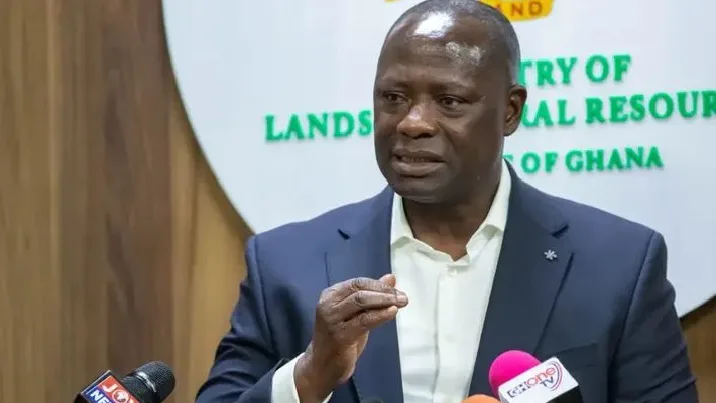
The Minister for Lands and Natural Resources, Emmanuel Armah-Kofi Buah, has announced that Ghana has become the first country in Africa and the third globally to receive verified forest carbon credits under the Architecture for REDD+ Transactions (ART), through its REDD+ Environmental Excellence Standard (TREES).
Addressing the media at the Ministry’s conference room on November 23, 2026, the Minister said Ghana had been issued approximately 6.5 million tonnes of verified emission reductions, marking a major milestone in the country’s efforts to protect its forests and tackle climate change.
He noted that the achievement, approved on November 10, 2026, was the result of nearly two decades of sustained efforts.
“We have taken this journey since 2008. Successive Governments have contributed to making sure we continue to protect our forests”, Mr. Buah said.
Chief Executive of the Forestry Commission, Dr Hugh C.A. Brown stated that the credits were earned through measurable results in reducing deforestation and forest degradation, rather than simply allocated to the country.
He explained that the process involved extensive monitoring, reporting and independent verification of Ghana’s forest conservation efforts.
“These credits were not simply allocated to Ghana. They were earned through results that had to be achieved, measured, reported, independently validated, and verified,” he said.
Dr Brown disclosed that buyers, including members of the LEAF Coalition, have committed to purchasing four million tonnes of the credits, valued at approximately $43 million, at prices ranging between $10 and $13 per tonne.
He revealed that the remaining 2.5 million credits are available for further transactions, with the potential to generate an additional $25 million.
The Chief Executive of Forestry Commission however, clarified that the issuance of the credits does not mean Ghana has received the money, explaining that Government is yet to receive the proceeds from the committed purchases.
He added that the approved benefit-sharing arrangement allocates 46 per cent to communities, farmers and traditional authorities, while 39 per cent goes to Government institutions, including the Forestry Commission and district assemblies.
Dr Brown noted that the credits cover emission reductions achieved between 2017 and 2021, with the next monitoring period covering 2022 to 2026.
He warned that illegal mining, illegal logging, wildfires and unsustainable farming practices continue to threaten the country’s forests and could affect future carbon credit earnings.
He assured that the Forestry Commission would continue working with Government, traditional authorities and local communities to protect forests and sustain the gains made.