


















































The Minerals Income Investment Fund (MIIF) has mobilised more than GH¢9 billion in mineral royalties as of October 2026, surpassing its annual target of GH¢6.9 billion with two months remaining in the year.
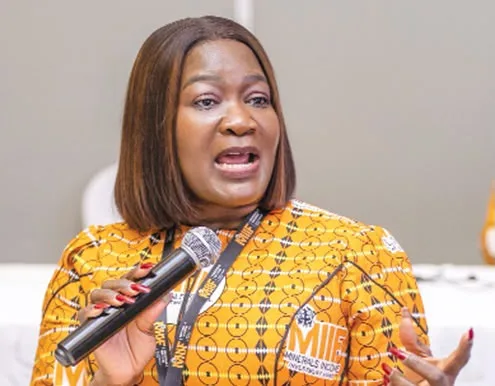
According to the Daily Graphic newspaper monitored by Angelonline on Monday November 24, the Chief Executive Officer (CEO) of MIIF, Justina Nelson, disclosed this at the Invest Ghana Summit 2026 in Accra, where she attributed the performance to improved revenue mobilisation, increased gold production and the introduction of a sliding-scale royalty regime.
Speaking during a breakaway session on Mining, Minerals and Downstream Value Addition, she said the Fund’s revenue mobilisation had recorded significant growth over the past few years.
Mrs Nelson revealed that mineral royalty receipts had risen from GH¢1.25 billion in 2020 to GH¢5.43 billion in 2025, representing a 334 per cent increase. The Fund also posted a profit of GH¢1.1 billion in 2025.
She linked the improved performance partly to Ghana’s increased gold output, which rose by 23.41 per cent in 2025, from 4.82 million ounces to 5.94 million ounces.
Small-scale mining contributed 3.11 million ounces, accounting for 52.4 per cent of the country’s total gold production during the period.
The MIIF CEO said the Fund’s mandate went beyond collecting mineral royalties, stressing the need to manage and invest the proceeds prudently to generate sustainable returns for national development.
She explained that MIIF was shifting its investment focus towards supporting domestic processing, refining and manufacturing to reduce Ghana’s dependence on exporting raw minerals.
Mrs Nelson consequently urged stronger partnerships between government, mining companies, investors, technology providers and development partners to unlock greater economic value from the country’s mineral resources.
She also encouraged investors to explore opportunities beyond mineral extraction, particularly in processing, refining, infrastructure and other related industries.
Outlining the Fund’s investment priorities, Mrs Nelson identified gold beneficiation, critical minerals development, and support for local businesses and infrastructure as three major areas of focus.
On gold beneficiation, she said MIIF was considering equity and revenue-sharing arrangements with internationally accredited domestic refineries, as well as investments in gold assay infrastructure.
“We are exploring strategies in equity and revenue-sharing opportunities in internationally accredited domestic refineries, alongside investments in gold assay infrastructure,” she said.
She added that the Fund was exploring opportunities in gold-backed exchange-traded funds, locally owned digital gold products and partnerships with international bullion banks.
“We are also assessing opportunities in gold-backed exchange-traded funds, locally owned digital gold products and partnerships with international bullion banks. These initiatives could strengthen domestic financial markets and retain more value within Ghana,” she added.
According to her, such initiatives could strengthen Ghana’s domestic financial markets while ensuring that more value generated from the country’s gold resources remains within the economy.
On critical minerals, Mrs Nelson disclosed that MIIF was assessing investment opportunities in manganese processing at Nsuta, particularly the production of high-purity manganese sulphate for use in electric vehicle batteries.
She also highlighted the potential of developing an integrated aluminium industry that would connect bauxite mining to alumina refining, smelting and downstream manufacturing.
The CEO further indicated that the Fund was positioning itself as a long-term co-investment partner to attract capital into strategic sectors, indigenous businesses and infrastructure development.
She said priority areas included engineering, equipment supply, logistics and energy infrastructure, where targeted financing and strategic equity investments could strengthen local participation in the mining value chain.
Mrs Nelson stressed that MIIF’s approach was to attract private investment, share financial risks and support commercially viable projects capable of expanding Ghana’s industrial capacity while delivering sustainable returns.
She noted that the transformation of the mining sector would require a collective commitment, with government providing the necessary policy direction, investors bringing capital and expertise, and mining companies deepening local participation.
Technology providers and development partners, she added, would also be required to help build the technical capacity needed to make Ghana’s mining industry more competitive.
“MIIF is ready to work with these partners to identify bankable opportunities, structure investments and mobilise the capital needed to move Ghana’s mineral sector beyond extraction,” she stated.
Mrs Nelson also attributed part of the Fund’s improved revenue performance to the introduction of the sliding-scale royalty framework, which adjusts royalty rates in line with prevailing mineral prices.
The arrangement allows the government to earn higher royalties when mineral prices increase, replacing the previous system under which non-small-scale gold mining companies paid a flat five per cent royalty regardless of market price fluctuations.
The new framework is intended to ensure that the State, as the owner of the country’s mineral resources, receives a fairer share of the economic gains during periods of favourable commodity prices.
The regulation also covers critical minerals, including lithium, as Ghana seeks to maximise revenue from its mineral resources while positioning the sector to contribute more significantly to industrial development.
Source: Abigail Ekua Arhin