


The Managing Director of the Ghana Water Company Limited (GWCL), Adam Mutawakilu, has outlined urgent measures to secure a stable water supply for Tarkwa and its surrounding communities.
This comes as the Bonsa Water Treatment Plant faces a renewed shutdown due to heavy siltation and illegal mining upstream.
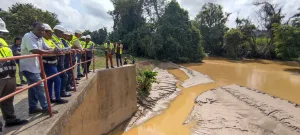
During a familiarisation tour of the Bonsa Treatment Plant in Tarkwa, Mr. Mutawakilu stated that the visit was aimed at assessing the rapidly deteriorating condition of the raw water source and exploring alternative options to keep water production running.
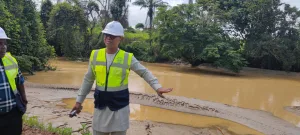
According to him, the Bonsa extraction point, which was desilted only a few weeks ago, has become heavily silted again in less than three weeks.
This is a worrying indication that the soil structure upstream has weakened significantly due to persistent illegal mining and land degradation.
For the past three weeks, the plant has been unable to treat water, leaving Tarkwa and surrounding communities without GWCL-supplied potable water.
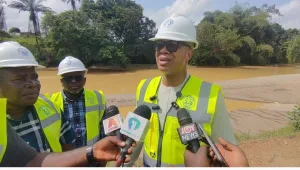
As part of immediate interventions, Mr. Mutawakilu announced plans to visit the new treatment plant under construction at Sekondi-Daboase, as well as inspect nearby mining pit lakes that may serve as alternative sources of raw water.
Contrary to popular belief, he explained that many mining pit lakes are not polluted. Abandoned mining pits often intersect underground aquifers, creating natural reservoirs of clean water that can be treated for public consumption.
With the Bonsa plant producing about 5,000 cubic metres of water per day under normal conditions, he noted that an aquifer-fed pit lake could sustain operations for several years if adopted as an alternative water source.
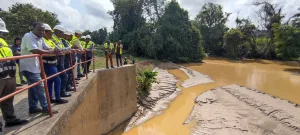
Mr. Mutawakilu emphasised that while the government intensifies its fight against illegal mining, GWCL is simultaneously working to identify sustainable water sources to ensure an uninterrupted supply to consumers.
The Western Regional Manager of GWCL, Mr. Richard Essoun, also highlighted the severity of the situation, stating that the company can no longer bear the recurring financial burden caused by illegal mining activities.
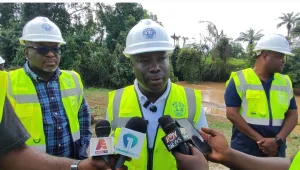
He explained that the Bonsa River has become so compromised that even after heavy investment in dredging, the river returns to crisis levels within days. This affects both the water volume and turbidity, often pushing levels beyond what the plant’s treatment system can handle.
“What we are witnessing now is beyond normal environmental impact; it is an emergency. The river cannot sustain the plant in its current condition. Every time we clear the silt, it returns within days. This is not sustainable,” he said.
Mr. Essoun revealed that the situation has deteriorated so badly that the Bonsa facility, designed to produce five million gallons of water per day, is now operating at less than 1,000 cubic metres, less than a quarter of its capacity.
He warned that the steep drop in production has crippled revenue generation, noting that the meagre income from producing under 1,000 cubic metres of water is nowhere near enough to cover the costs of continuous dredging.
“The plant is supposed to do five million gallons a day, but now we are doing under a thousand cubic metres. The plant is virtually dead,” he stressed.
He thus appealed to regulators, security agencies, and local authorities to intensify efforts to protect the Bonsa River, warning that without swift intervention, the entire Tarkwa municipality could face prolonged water shortages.
As a response to these worsening conditions, Mr. Essoun confirmed that GWCL is now turning to mining pit lakes as a temporary but urgent alternative to keep water flowing to consumers.
Source: Nana Fynn Takoradi


