


President John Dramani Mahama has stated that education remains the first line of protection in any crisis, emphasizing that it is essential for stability and long-term recovery.
Speaking at the 23rd session of the Doha Forum 2025, President Mahama said “education is not a privilege, nor is it an afterthought of government policy, but an inherent right, a necessary condition for the dignity, empowerment, and full realization of every citizen.”
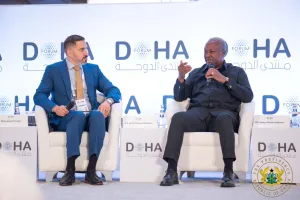
He added that this principle is firmly rooted in Ghana’s 1992 Constitution, which guarantees equal educational opportunities for all.
He stressed the urgent need for a stronger global commitment to education, warning that the world is currently facing multiple overlapping challenges including conflicts, economic shocks, climate instability, pandemics, and widening inequalities.
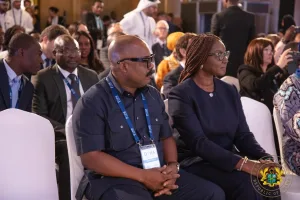
According to him, “these crises do not only disrupt economies, they disrupt childhoods. They do not only destroy infrastructure, they destroy the dreams of our children.”
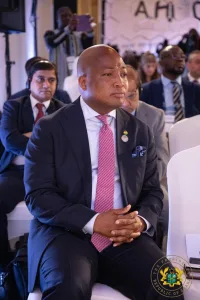
President Mahama said that, in such difficult times, education must serve as the battleground for justice.
“Education is justice when it ensures that a child uprooted by conflict does not lose her dreams,” he noted.
“Education is justice when learning continues despite pandemics, economic hardship, or climate disasters.”
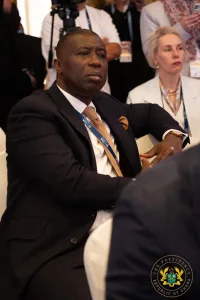
He emphasized that “in every crisis, education stands as the first line of protection, the most reliable social stabilizer, and the foundation on which long-term recovery can be built. And this is why education in emergencies must be seen as lifesaving and not optional.”
The president also commended the Doha Forum for recognizing individuals working to close learning gaps in crisis-affected regions, describing it as a step toward strengthening education in emergency contexts.
President Mahama further highlighted that the disruption of education in conflict zones is becoming one of the greatest humanitarian tragedies of the era.
He said the world cannot ignore the struggles of “the current generation of children in Gaza, Afghanistan, Sudan, and other places,” warning that the effects will be felt for decades.
He called on the global community to protect education budgets, integrate education into humanitarian response plans, ensure the safety of schools, accelerate digital inclusion, and support teachers as stabilizing forces in society.
“Economic austerity should not begin in the classroom,” he cautioned.
The president also stressed that education is central to achieving the Sustainable Development Goals, stating that “without education, we cannot end poverty, we cannot achieve good health, we cannot attain gender equality, we cannot build decent work and economic growth and we cannot secure peace, justice, and strong institutions.”
He urged world leaders to rethink their approach to learning, saying education must be “transformational, not transactional; equitable, not exclusive; forward-looking and not outdated.”
Turning to Ghana’s progress, President Mahama noted that the country has pursued bold reforms to expand opportunity and strengthen justice through education.
“Our free basic and secondary education has enabled millions of Ghanaian youth to access education regardless of their family income,” he stated.
He added that Ghana’s investments in TVET, digital literacy, and early childhood development reflect its commitment to building a resilient and equitable education system.
Reflecting on the COVID-19 pandemic, he explained how countries worldwide adopted innovative strategies, including radio and TV learning programs, digital platforms, community teaching, and teacher support to ensure that “no child was abandoned in a moment of global crisis.”
The pandemic, he said, proved that education systems can be built with resilience at their core.
President Mahama concluded by calling for sustained international cooperation, saying “Justice is not only delivered in the courtrooms. Justice lives in the classrooms. It is found in the moment a child learns to read, or a displaced child finds safety and hope in a school.”
He urged the world to invest boldly in education, adding “Knowledge is like a garden. If it is not cultivated, it cannot be harvested.”


