



















































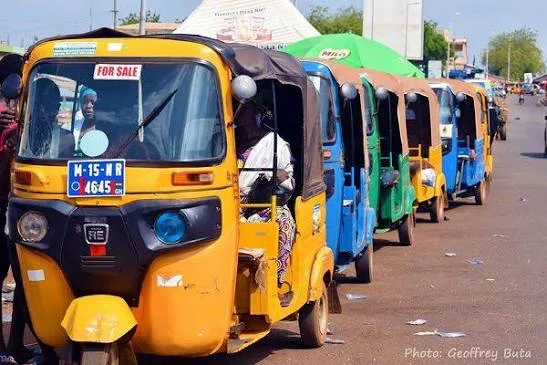
Motor Traffic and Transport Department (MTTD) prepares to intensify enforcement of road safety regulations. Passengers travelling in commercial tricycles, popularly known as pragyia, could face arrest and up to eight months’ imprisonment for failing to wear protective helmets.
The warning means that passengers who board the three-wheel vehicles for their daily journeys to work, markets and other destinations could face the same legal consequences as operators who disregard the prescribed safety requirements.
According to The New Publisher newspaper monitored by Angelonline on Wednesday November 24, Chief Inspector Frimpong Ayeh of the MTTD said the law does not exempt passengers travelling in commercial tricycles from wearing helmets, despite public perceptions that the vehicles offer protection similar to that of conventional cars.
“Those who ride in or sit inside a tricycle (pragyia) are required by law to wear helmets. I know some people say it is like a car, not a motorcycle, but the law says you must wear a helmet. The Oda Division has warned that as part of its upcoming enforcement operations, passengers found travelling without helmets will also be arrested,” he cautioned.
He cautioned that the Oda Division would arrest passengers found without helmets during its forthcoming enforcement exercise.
According to him, both operators and passengers are expected to observe the safety requirements.
Regulation 109 of the Road Traffic Regulations, 2012 (L.I. 2180), requires riders and passengers to wear approved protective helmets with their chin straps properly secured, alongside reflective clothing.
The regulation further places responsibility on operators to ensure that passengers below the age of 18 comply with the safety provisions.
Offenders risk fines ranging from 25 to 50 penalty units, imprisonment for between one and three months, or both.
However, Regulation 176(2) prescribes a potentially stiffer punishment for commercial passengers who fail to wear helmets, including fines of 25 to 50 penalty units, imprisonment for up to eight months, or both.
The impending enforcement has, however, triggered disagreement among tricycle operators and road safety authorities over whether the helmet requirement was originally intended to cover commercial passenger tricycles.
The National Union of Tricycle Operators has questioned the directive, with its representatives insisting that the requirement was never part of agreements reached during consultations with relevant regulatory bodies.
Kenneth Adu Akwabeng of the union said members were taken aback by the announcement, explaining that previous engagements with the National Road Safety Authority (NRSA), the Driver and Vehicle Licensing Authority (DVLA) and other stakeholders had not suggested such a requirement.
He said the union was surprised to see the directive reported in the media, given the discussions held with the authorities.
“Honestly, when this new law came into existence, we had several meetings with the National Road Safety Authority, the DVLA and all the other stakeholders involved. So, when we saw this news in the media yesterday, we were shocked because this was not what we discussed with the various agencies,”
Adding to the controversy, NRSA Director-General Abraham Amaliba has described the provision compelling pragyia operators to wear helmets as an error, arguing that the framers of the law did not intend to extend the requirement to commercial passenger tricycles.
Speaking on Joy FM’s Midday News on Tuesday, November 24, Mr Amaliba said the provision was intended for operators of ‘aboboya tricycles’, which are primarily used for transporting goods.
“The provision that talks about tricycle drivers wearing a helmet is a mistake. That was not the intention of the framers of the law. Those who are supposed to wear helmets are the aboboyaa, and not tricycles,” he stated.
He maintained that pragyia vehicles should be treated in the same manner as taxis because both serve as means of transporting passengers.
Mr Amaliba argued that since taxi drivers are not required to wear helmets, operators of passenger tricycles should not be subjected to the same obligation or required to provide helmets for their passengers.
“A taxi is a minicar, and minicar drivers, or drivers who drive taxis, don’t wear helmets. So pragyia drivers are not supposed to wear helmets, and they are not even supposed to provide helmets for their passengers. So it’s a mistake,” he explained.
He attributed the controversy to the classification of both aboboyaa and pragyia as tricycles under the existing regulations, despite their distinct purposes.
The NRSA Director-General said the authority would engage the MTTD to determine how the issue should be addressed but did not indicate when the disputed provision would be amended or repealed.
Meanwhile, the regulations governing commercial motorcycle operators, commonly known as Okada riders, expressly require them to provide approved helmets for passengers and ensure the protective equipment is properly fastened, clean and maintained.
Although the regulations do not make a similar explicit provision requiring pragyia operators to supply helmets to passengers, the general safety requirements under the law still prescribe helmet use for both riders and passengers.
Until the relevant regulations are formally amended, the existing legal provisions remain in force, leaving pragyia operators and passengers potentially liable to the penalties stipulated under the law.
Source: Abigail Ekua Arhin