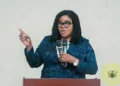

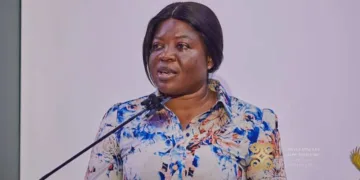






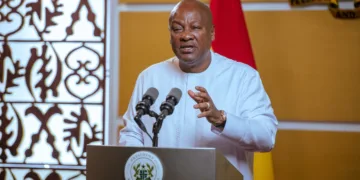












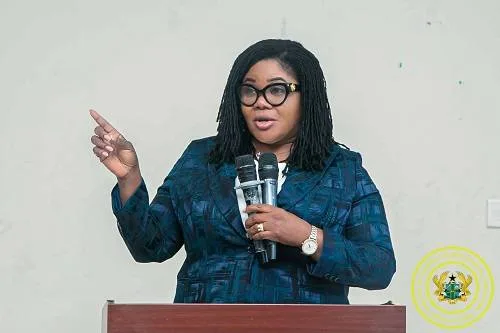
The Minister for Gender, Children and Social Protection, Dr. Agnes Naa Momo Lartey (MP), has decried the failure to deliver justice for survivors of gender-based violence, saying too many survivors who find the courage to report never get justice, while too many perpetrators face no consequences.
She made the call as the Ministry of Gender, Children and Social Protection announced Ghana’s observance of the 2026 16 Days of Activism against Gender-Based Violence, from Wednesday, November 25 to Thursday, December 10, 2026.
The campaign is being held under the global theme: “UNiTE to End Violence Against Women and Girls: Ensure Justice, Protect Survivors, End Impunity.”
“This must change,” Dr. Lartey said. “Our laws are strong, but a law only protects a woman if she knows about it, can use it, and sees it enforced.”
The 16 Days run from November 25, the International Day for the Elimination of Violence against Women, to December 10, Human Rights Day. By linking the two days, the campaign sends a clear message that violence against women and girls is a violation of human rights, not a private family matter.
Since it began in 1991, the campaign has grown into a global movement observed in more than 180 countries. Ghana joins it again this year because, despite real progress, violence against women and girls remains a daily reality in too many homes, communities, schools and workplaces, and increasingly in online spaces.
The scale of the problem is significant. According to the 2022 Ghana Demographic and Health Survey, two in every five women aged 15 to 49 (41.6 per cent) have experienced emotional, physical or sexual violence from an intimate partner. One in three women has experienced physical violence since the age of 15, and more than one in ten has experienced sexual violence from an intimate partner. Sixteen per cent of young women aged 20 to 24 were married before their 18th birthday, and in some districts more than six in ten women have experienced domestic violence.
“Behind every one of these numbers is a mother, a daughter, a sister or a friend,” Dr. Lartey said.
Violence is also taking new forms. Earlier this year, Ghanaians were shocked when intimate images of women were recorded and shared online without their consent. The Ministry reminded the public that sharing such images, or threatening to share them, is a crime under the Cybersecurity Act, 2020 (Act 1038), and that anyone who forwards them is also liable.
In line with the global theme, Ghana’s campaign will therefore focus on closing the gap between reporting and justice, and on ending impunity both offline and online.
Working with its partners, the Ministry is planning a programme of activities at national, regional and community levels. These will raise public awareness, strengthen support and access to justice for survivors, and bring institutions and communities together to end impunity for violence against women and girls.
The campaign will also mark the International Day for the Elimination of Child, Early and Forced Marriage (November 27), World AIDS Day (December 1), the International Day of Persons with Disabilities (December 3), and Human Rights Day (December 10). Together, they are a reminder that violence affects girls at risk of child marriage, women living with HIV and women with disabilities in particular ways, and that no one must be left behind.
The Ministry called on all Ghanaians to support the campaign. It urged chiefs, queen mothers and religious leaders to use their voices in palaces, churches and mosques to condemn violence and encourage reporting, and appealed to parents and families never to hide abuse to protect the family name, but to protect the woman or child instead.
Young people are asked not to share, forward or download anyone’s private images, and to speak up when they see abuse online, while men and boys are invited to stand as allies. Employers are encouraged to make their workplaces safe and to support staff affected by violence.
The Ministry thanked development partners and civil society for their continued support, and called on the media to help carry the campaign’s messages to every corner of Ghana and to report on violence in ways that protect survivors.
The Ministry urged members of the public to wear orange during the 16 Days and to share the campaign’s messages using #16Days, #OrangeGhana and #EndImpunityGH.
She further directed anyone experiencing violence, or who knows someone who is, to report to the Domestic Violence and Victim Support Unit (DOVVSU) of the Ghana Police Service, the nearest police station or a Department of Social Welfare office. Help is also available through the Orange Support Centre on its toll-free line 0800 111 222 and on WhatsApp on 055 175 7575, the Helpline of Hope on the toll-free lines 0800 800 800 and 0800 900 900, DOVVSU on 0551000900, and the Police on the toll-free line 18555.
“Every woman and girl in Ghana has the right to live free from violence and fear.
“Together, we can ensure justice, protect survivors and end impunity. As we approach the festive season, I wish every Ghanaian a safe, peaceful and violence-free Christmas and New Year, and a violence-free Ghana for every woman and girl,” Dr. Lartey added.