


The Minister for Works and Housing, Kenneth Gilbert Adjei, has assured residents of the Sekondi–Takoradi Metropolis and surrounding communities that the government is on course to significantly improve water supply, as the expansion of the Daboase Water Treatment Plant nears 98 per cent completion.
This assurance was given during a two-day working visit to the Western Region, where the Minister inspected ongoing expansion works at both the Daboase and Inchaban Water Treatment Plants.
According to Adjei, the inspection team first visited Daboase to assess the progress of the water projects currently underway.
“From what I have seen so far, everything is going on well. The project is not behind schedule. There are a few challenges, but as government, we are working to resolve them so that the project can be completed in the next few months, hopefully by May,” the Minister stated.

He disclosed that the Daboase Water Treatment Plant expansion is now about 98 per cent complete, with only a few remaining tasks to be finalised.
“This means there is just a few percentage left to complete. All things being equal, we are looking at May,” he added.
The Minister further assured residents of Sekondi–Takoradi and the surrounding industrial and residential areas that the government is fully aware of the persistent water challenges in the metropolis and remains committed to addressing them.
He also expressed concern about the effect of illegal mining activities on the Daboase Water Treatment Plant, noting that galamsey continues to pollute raw water sources and complicate treatment processes.
According to him, heavily polluted water increases turbidity levels and chemical demand, putting additional pressure on treatment systems and raising operational costs.
The Minister warned that if galamsey activities along rivers and water bodies are not brought under control, the full benefits of the expanded treatment plant could be undermined.
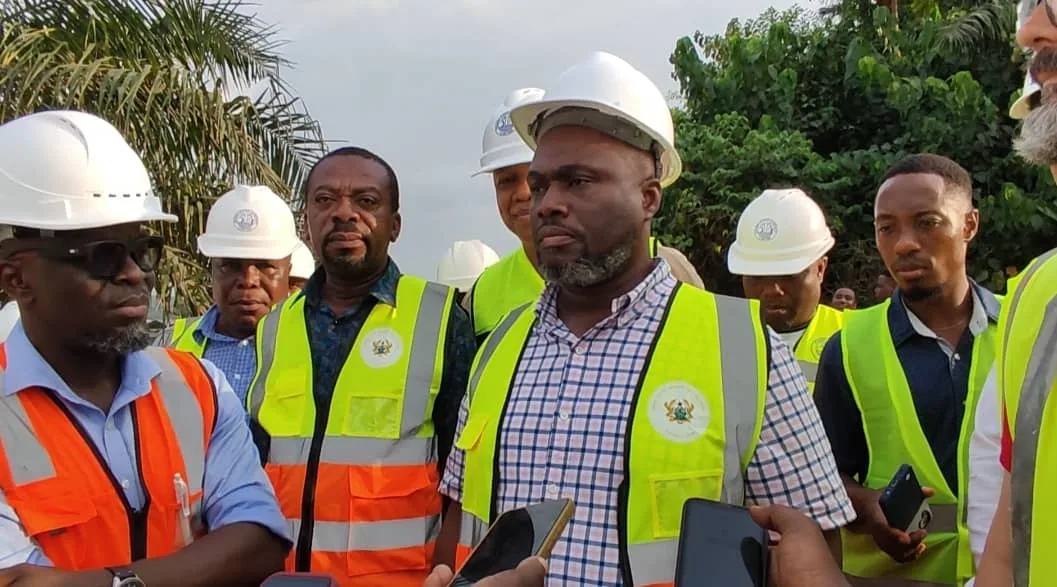
He therefore called for stronger collaboration among security agencies, local authorities, and traditional leaders to protect water sources and safeguard government investments.
The Daboase Water Treatment Plant expansion forms part of a major government water supply project being implemented through the Ministry of Sanitation and Water Resources and the Ghana Water Company Limited to address water shortages in the Sekondi–Takoradi Metropolis and nearby towns.
The project involves the construction of a new conventional water treatment facility capable of producing 22 million gallons of treated water per day, a significant increase from the old plant’s capacity of approximately 6 million gallons per day.
This project is being executed by the Austrian construction firm Strabag Engineering under a €70 million investment that commenced in May 2022.
Providing technical details, the Project Manager for Strabag Engineering, Mr. Vlad Falup, explained that raw water is conveyed to the treatment plant through a 1,200-millimetre transmission pipeline from the intake point.
He stated that the water first enters a distribution chamber designed to split the flow between the current phase of the project and future expansions.
From there, the water undergoes pre-sedimentation to remove large particles, followed by flocculation and clarification, where chemicals such as aluminium sulfate, polyaluminium chloride, and polyelectrolytes are added to bind fine particles into heavier clusters, which then settle and are removed.
After this stage, the water is already visually clear, but very fine particles remain. To remove these, the water passes through dual-media filters made of sand and anthracite.
The final stage of treatment involves disinfection using chlorine gas or calcium hypochlorite before the treated water is transmitted to the Sekondi–Takoradi area.
Mr. Falup added that the plant is equipped with a high-lift pumping station with six pumps installed to send treated water to Takoradi, along with auxiliary facilities including an administration building, workshop, chemical storage and dosing buildings, electrical buildings, and a backwash system used to clean filters every 48 hours.
According to him, the project is at an advanced stage, with most major installations completed. What remains are finishing works, such as internal roads, final painting, testing, and other minor tasks.
Once completed, the expanded Daboase Water Treatment Plant, together with improvements at the Inchaban facility, is expected to significantly ease water shortages and meet the growing water demand of residents, businesses, and industries in the Sekondi–Takoradi Metropolis and the wider Western Region.
Source: Nana Fynn


