


President John Dramani Mahama last Friday delivered a calm but confidence boosting assessment of Ghana’s current economic trajectory in the second State of the Nation Address in his second term.
After years of hardship marked by high inflation, a weakening cedi, debt restructuring and sluggish business activity, President Mahama’s remarks echoed what many households and firms are beginning to feel on the ground and in their pockets – the easing pressure.
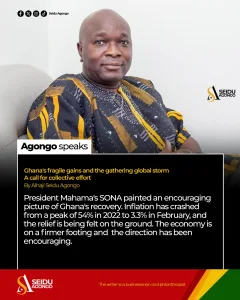
Key indicators are stabilising, macroeconomic trends are becoming more predictable, and more importantly, the early signs of a genuine recovery are emerging.

Realities in jargons
Though jargons and sometimes annoying to the ordinary person, these economic metrics and indices are better reflected in the daily cost of living and items on the streets and in corner shops nationwide.
For many households, the moderation of inflation from a peak of 54% in 2022 to around 23% in 2024 before crashing to 3.3.% in February has translated into slower increases in food, transport, and utility costs.
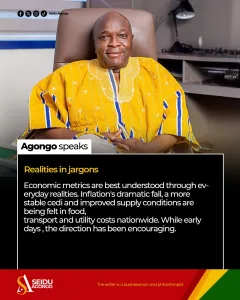
For businesses, a relatively more stable cedi and improved supply conditions have helped reduce the uncertainty that made planning difficult in the past.
President Mahama’s national address underscored these improvements, echoing what traders in the markets, manufacturing firms, and ordinary workers have begun to feel in their pockets and bottom lines.
While there is room for improvement, the direction has been encouraging.
Cocoa crisis, stormy world
But just as Ghana appeared to be rebuilding stability, events beyond the country’s borders have introduced new and immediate threats.
First was the record crash in cocoa prices in the international market.
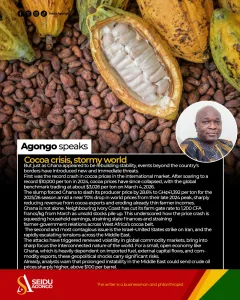
After soaring to a record $10,000 per ton in 2024, cocoa prices have since collapsed, with the global benchmark trading at about $3,026 per ton on March 4, 2026.
The slump forced Ghana to slash its producer price by 28.6% to GH¢41,392 per ton for the 2025/26 season amid a near 70% drop in world prices from their late 2024 peak, sharply reducing revenue from cocoa exports and eroding already thin farmer incomes.
Ghana is not alone.
Neighbouring Ivory Coast has cut its farm gate rate to 1,200 CFA francs/kg from March as unsold stocks pile up.
This underscored how the price crash is squeezing household earnings, straining state finances and straining farmer-government relations across West Africa’s cocoa belt.
The second and most contagious issue is the Israel–United States strike on Iran, and the rapidly escalating tensions across the Middle East.
The attacks have triggered renewed volatility in global commodity markets, bring into sharp focus the interconnected nature of the world.
For a small, open economy like Ghana, which is heavily dependent on imported fuel, external capital flows, and commodity exports, these geopolitical shocks carry significant risks.
Already, analysts warn that prolonged instability in the Middle East could send crude oil prices sharply higher, above $100 per barrel.
Implications
For Ghana, this would mean higher fuel pump prices, increased transport fares, rising production costs for businesses, and potential upward pressure on inflation.
A spike in oil prices often triggers currency volatility as well, given Ghana’s import bill.
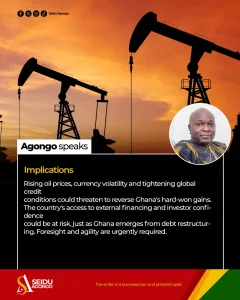
Businesses working hard to rebuild margins could face new cost pressures, and households may once again find their budgets strained.
Beyond oil, global investor sentiment tends to deteriorate during geopolitical crises.
This could affect Ghana’s access to external financing, delay investment decisions, or tighten global credit conditions just as the country is emerging from debt restructuring and attempting to re-establish market confidence.
The gains highlighted in the national address, while real, are therefore at risk unless managed with foresight and agility.
Why Ghana is a step ahead
One of Ghana’s advantages, however, is experience.
The country has navigated multiple global and domestic crises over the past decades — commodity price shocks, pandemics, financial sector reforms, fiscal consolidations, and international market disruptions.
Effective crisis management has often relied on a combination of strong policy responses, public cooperation, and resilience among businesses and households.
The current moment calls for the same level of collective steadiness.
Fortunately, President Mahama, a former member of Parliament, minister, vice and president has seen it all.
He was President when Ghana experienced one of its heaviest capital flights from 2013 into 2016 resulting from a tumbling exchange rate, alongside the debilitating energy crisis.
With tenacity, however, he fixed the power problems and exited office with Ghana having excess installed capacity – gains that have served us till now.
Thus, while the world navigates the current stormy system, local policymakers will need to tap these experiences and deploy people-centered measures.
The introduction of stringent fiscal measures, the Gold Board and increased revenue efforts have helped to build the country the needed buffers, but those gains require further oiling to withstand the shocks that recent events bring.
We would need to accelerate efforts to boost domestic food production and support small and medium-sized enterprises , which are the backbone of Ghanaian employment to reduce our reliance on imports.
The individual’s role
But equally important is the role of individuals and businesses.
Ghanaians cannot afford to be passive observers in this unfolding global uncertainty.
Households may need to adopt more deliberate financial planning, reduce unnecessary expenses, and diversify income where possible.
Businesses would have to be more proactive and discipline, anticipating the challenges and reducing exposure to the contagion.
This period also presents an opportunity for innovation.
Digital tools, renewable energy solutions, improved logistics systems, and smarter business models can help firms remain competitive even in turbulent times.
More importantly, we must unite in our actions and words.
The polarized nature of the world requires that nations move in unison, knowing who they are and what they want.
We must pass whatever text that these developments bring us, as we have triumphed over the bitter COVID19 pandemic, debt restructuring and the economic malaise they brought.
The writer is a businessman and philanthropist


