


The National Anti-Illegal Mining Operations Secretariat (NAIMOS) has mounted series of coordinated anti-illegal mining operations across multiple fronts in the Western Region on Saturday, April 11, 2026.
The Secretariat targeted illegal mining networks along the Ankobra and Butre rivers, while extending its reach into the night to deny operators any refuge under the cover of darkness.
Raid at Gwira Banso, Nzema East District — Ankobra River
The day’s operations commenced at about 0730 hours when NAIMOS personnel, operating alongside the Blue Water Guards, moved onto a mining pit along the Ankobra River at Gwira Banso in the Nzema East District.

What the task force encountered upon arrival underscored the scale of illegal mining activity along the River.
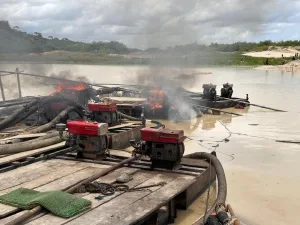
Approximately 30 Changfan machines had been mounted on improvised floating platforms, with an extensive network of canals constructed to redirect slurry and toxic wastewater directly back into the Ankobra River.
The environmental implications were stark, with the deliberate contamination posing grave risks to aquatic life and the downstream communities that depend on the river for domestic use.
In a swift and coordinated response, NAIMOS personnel moved to disrupt the operations.
On sighting the approaching task force, several miners abandoned their equipment and fled into nearby bushes.
All Changfan machines, floating platforms, and associated equipment were subsequently destroyed and set ablaze to prevent reuse, concluding the Gwira Banso phase of operations at about 1648 hours.
Operations at Mpohor Yaabi, Ahanta West District — Butre River
Simultaneously, between 0800 and 1530 hours, a separate NAIMOS team conducted intensified offensive patrols within the Ahanta West District, with focus on illegal mining activities at Mpohor Yaabi, a tributary of the Butre River.
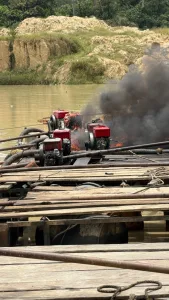
The task force encountered approximately 30 illegal miners actively engaged in gold extraction at the site.
As in Gwira Banso, the miners fled into surrounding vegetation upon sighting the approaching team, abandoning a significant quantity of equipment.
What the task force uncovered at Mpohor Yaabi extended well beyond equipment and machinery.
Preliminary assessments revealed alarming levels of environmental destruction, with large swathes of palm tree and bamboo plantations razed to create access routes and mining pits.
The Yaabi stream itself had been heavily diverted and obstructed, its natural course altered in ways that have measurably reduced water flow into the Butre River, with consequences for aquatic ecosystems and water availability for farming and domestic use in surrounding communities.
The task force dismantled and destroyed all equipment found on site, including 20 water pumping machines, 15 Changfan machines, several industrial and standard water hoses, 6 wooden gold washing platforms, and 7 makeshift structures that had been serving as living quarters for the illegal miners.
The structures were set ablaze and rendered unusable in line with NAIMOS operational guidelines aimed at denying illegal mining networks the logistical capacity to resume activities.
Operations conducted at Duale, Nzema East District — Night Operations on the Ankobra River
As daylight faded, NAIMOS did not stand down. At approximately 1830 hours, the Secretariat extended its operational reach to Duale in the Nzema East District, launching night patrols along the Ankobra River in direct response to an observed shift in the operational patterns of illegal miners who have increasingly sought to conduct their activities under the cover of darkness.
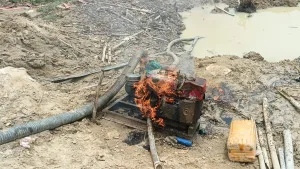
Adapting its strategy to match the evolving tactics of those it pursues, the NAIMOS taskforce adopted sustained night patrolling as a standing feature of its operational posture along the river, ensuring that neither day nor night offers sanctuary to those engaged in illegal mining.
The breadth and intensity of Saturday’s operations send an unambiguous message to illegal mining networks operating across the Western Region and beyond.
Whether on foot, by water, in daylight or at night, NAIMOS has demonstrated both the reach and the resolve to pursue its mandate without interruption.
The Secretariat will maintain continuous patrols and targeted interventions across all affected areas until the nation’s rivers, forests, and lands are fully restored and permanently protected.
Source: Kwadwo Baffour Atuahene


