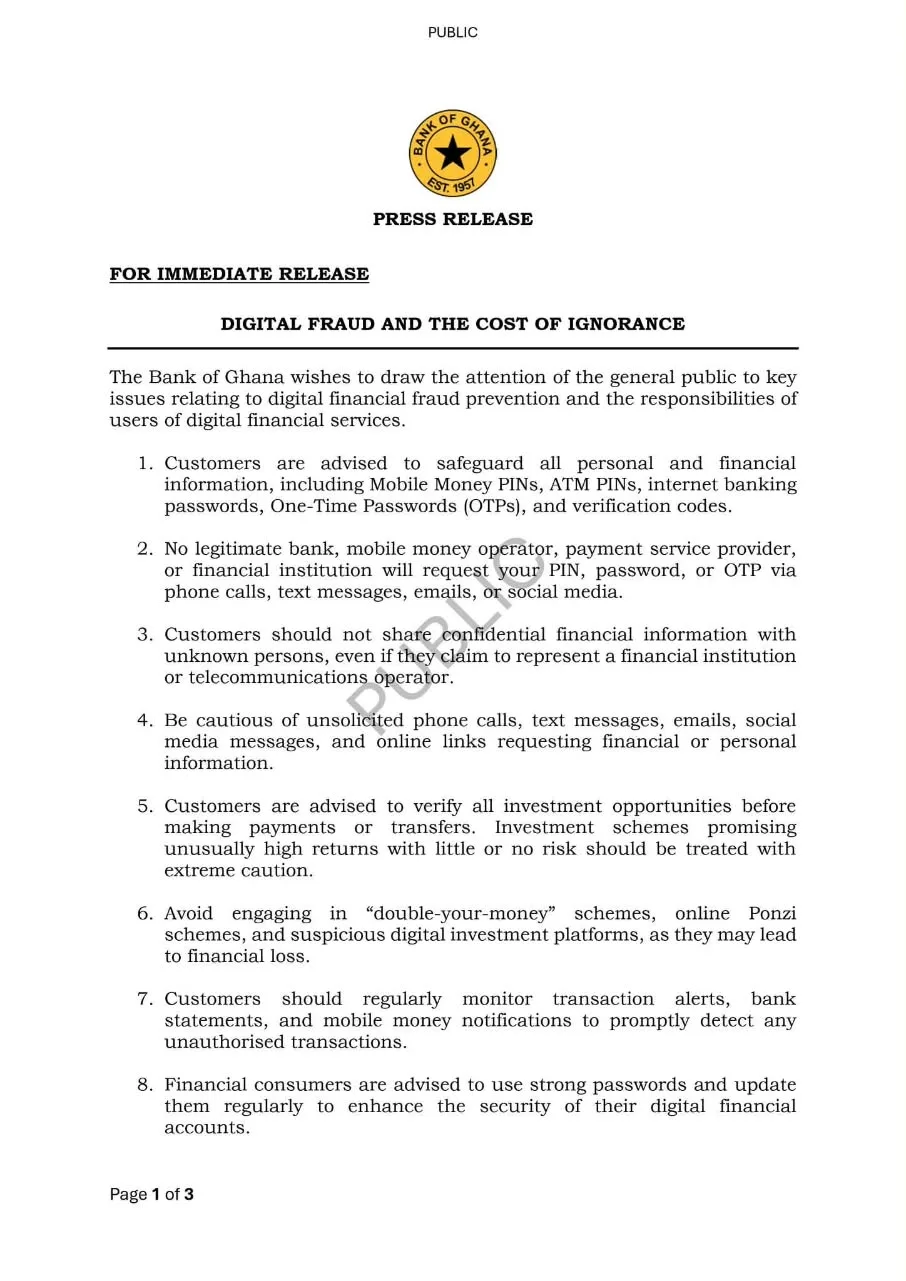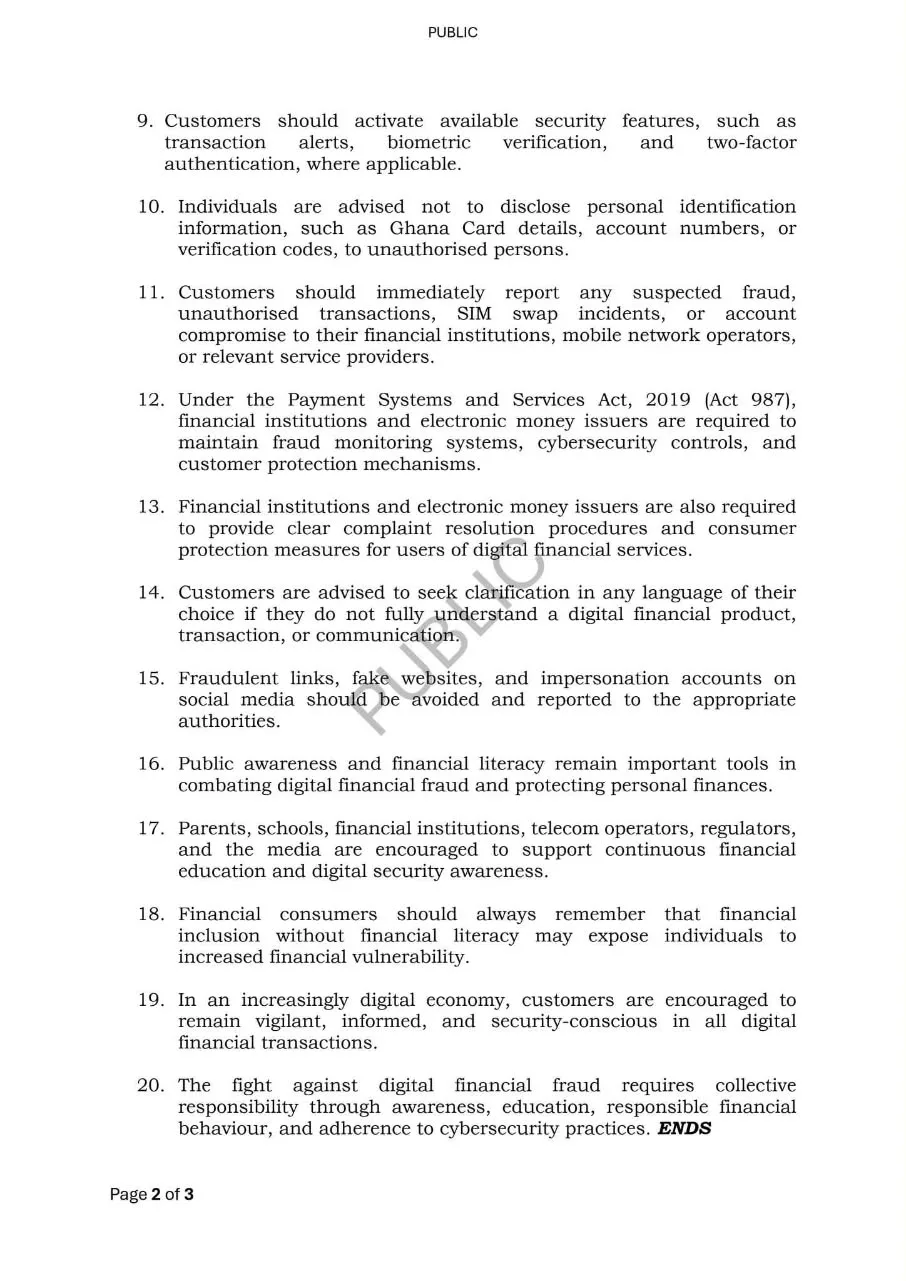


The Bank of Ghana (BoG) has warned the public against rising cases of digital financial fraud, saying financial inclusion without financial literacy exposes users to increased vulnerability.
In a statement, the central bank said customers must take responsibility for protecting their personal and financial information to avoid losses.
The Bank listed 20 safety measures, key among them that customers must safeguard their Mobile Money PINs, ATM PINs, internet banking passwords, One-Time Passwords (OTPs) and verification codes.
It stressed that no legitimate bank, mobile money operator, payment service provider, or financial institution will ever ask for a customer’s PIN, password, or OTP via phone calls, text messages, emails, or social media.
The BoG also cautioned the public not to share confidential financial information with unknown persons, even if they claim to represent a financial institution or telecom operator, and to be cautious of unsolicited calls, texts, emails, and online links requesting personal information.
On investments, the regulator advised customers to verify all opportunities before making payments, warning that schemes promising unusually high returns with little or no risk, “double-your-money” schemes and online Ponzi schemes should be treated with extreme caution.
For account security, it urged customers to regularly monitor transaction alerts and bank statements to detect unauthorised transactions, use strong passwords and update them regularly, and activate security features such as biometric verification and two-factor authentication.
Customers were also advised not to disclose Ghana Card details, account numbers, or verification codes to unauthorised persons, and to immediately report suspected fraud, SIM swap incidents or account compromise to their financial institutions and mobile network operators.
The Bank reminded financial institutions and electronic money issuers that under the Payment Systems and Services Act, 2019 (Act 987), they are required to maintain fraud monitoring systems, cybersecurity controls and clear complaint resolution procedures.
It further advised customers to seek clarification in a language of their choice if they do not understand a digital product, and to avoid and report fraudulent links, fake websites and impersonation accounts on social media to the appropriate authorities.
The central bank said public awareness and financial literacy remain key tools in combating fraud, and encouraged parents, schools, financial institutions, telecom operators, regulators, and the media to support continuous financial and digital security education.
It further said that fighting digital fraud requires collective responsibility through awareness, education, responsible financial behaviour and adherence to cybersecurity practices.
Read statement below: