






















































Renowned Africologist, Professor Molefi Kete Asante, has challenged African scholars to stop giving colonialism undue prominence in African history and education.
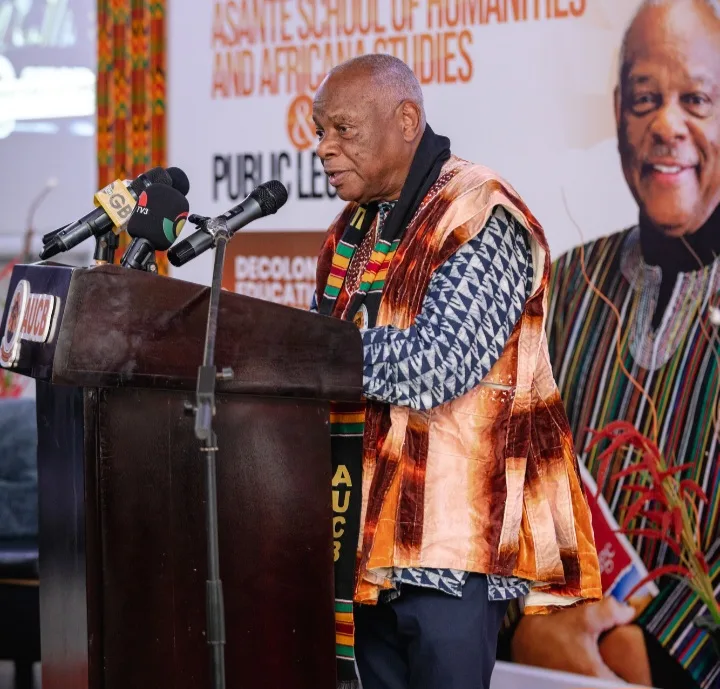
Prof. Asante, who is Professor of Africology and African American Studies at Temple University in the United States, made the call on Wednesday, October 21, 2026, when he delivered the African University of Communications and Business (AUCB) Distinguished Public Lecture at the AUCB Discovery House, Adabraka in Accra.
The lecture was on the theme “Decolonizing African Education to Meet Global Challenges.”
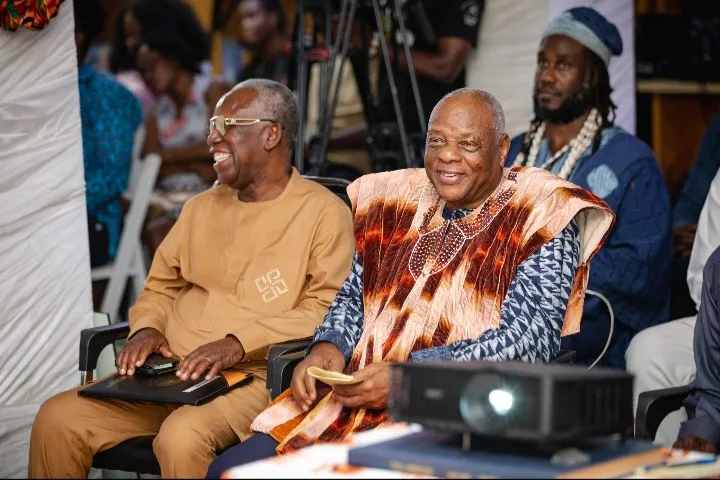
According to Prof. Asante, Afrocentricity is not about constantly talking about colonialism, but about asserting Africa’s own agency.
“The Afrocentrists argue that first of all we don’t like anything that says decolonize or decolonial… the colonial experience is a tiny period of time in African history and I don’t want to give them that credit that I’m always talking about the colonial,” he stated.
He distinguished between decolonization and Afrocentric assertion, explaining that while decolonization, removing statues of Queens of England and Cecil John Rhodes and other symbols that defined Africans as inferior, is necessary, it still keeps Europe at the centre.
“What you have from me is Afrocentric assertion. How do we assert our own epistemology regardless of what Europe has done?”
Prof. Asante argued that the current episteme taught in African universities is against Africans, noting that political science and philosophy are still taught without starting from Africa.
“The episteme as it is created is against us and we call for epistemic justice but in fact they won’t give us justice. Let us do our thing. We are agents, we create, we define them and our historical experiences,” he said.
Sharing his experience writing the history of Africa for Routledge Publishers, Prof. Asante said he refused to centre Europeans.
He recounted that the publishers wanted chapters on the British and Portuguese in Africa, but he insisted on writing Africa and its people.
“I’m writing the history of Africa. I will write of them as if we have to resist them, I will write of them as if they were intruders. You’re not gonna find me writing on the glorious history of the adventurers in Africa. No, they were longtime guys lost somewhere in the forest. That’s not the history that I want. I want the history of the men and women who created African societies and customs and traditions,” he stated.
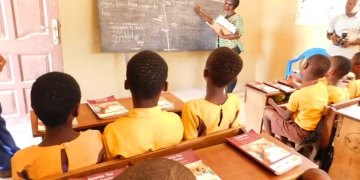
He further called for a practical overhaul of African education to meet contemporary challenges, urging universities to teach skills such as flood control, digital skills and entrepreneurship so graduates can create their own jobs rather than depending solely on theory.
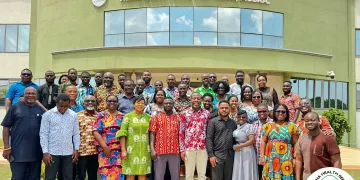
The lecture forms part of AUCB’s commitment to fostering critical dialogue on education, Africa’s intellectual development, and the role of higher education in addressing contemporary global challenges.